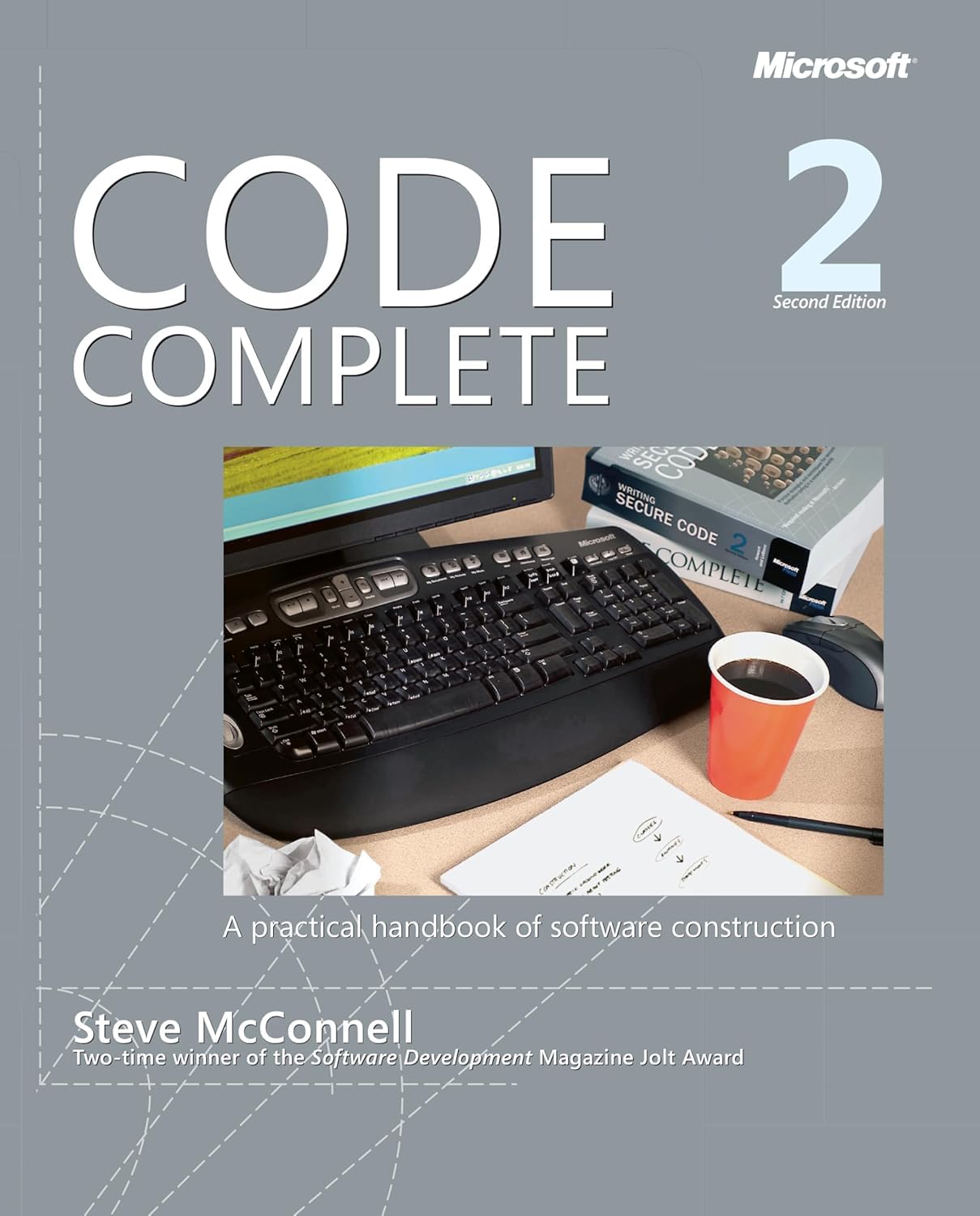
One source would be: https://www.oreilly.com/library/view/code-complete-2nd/07356...
- Believes most business logic doesn't belong in models/controllers
- Understands the importance of naming things (classes, variables, etc.) well
- Writes tests, even if not fully TDD
- Intelligently applies SOLID engineering principles
^^ this type of thing.
I think the books "Code Complete" [0] and "Practical Object-Oriented Design: An Agile Primer Using Ruby" [1] embody a lot of what I'm looking for, if you're familiar with them.
[0] https://www.amazon.com/Code-Complete-Practical-Handbook-Cons...
Edit: Formatting
The problem is telling individuals to focus on optimization.
Let's use javascript as an example. Say you need to transform an array. You can use `.map` or a `for` loop in javascript.
You see a lot of articles like this https://dev.to/henryjw/array-map-much-slower-than-for-loop-5... that say a `for` loop is faster. And sometimes it's true.
By the logic of the original article, you should hyperoptimize your code. The problem is. If everyone writes `for` loops instead of using `map`. When map eventually becomes more efficient there's all that garbage code out there that has to be refactored.
Ignoring the problems associated with benchmarking - this for example claims map now being faster than for loops. https://leanylabs.com/blog/js-forEach-map-reduce-vs-for-for_...
It comes down to return on effort. We only have so much effort to put at solving this problem. You maximize your return on effort by having a clear separation of responsibility. In this case the individual's responsibility is to write code to the latest spec. The institution's responsibility is to make the code written as efficient as possible.
A single website saving .000000001 ppm of carbon (exaggerating) is just never going to be worth the effort. But a compiler improvement on all websites running javascript. Now that's totally worth it.
Further reading behind this logic: https://www.goodreads.com/book/show/3828902-thinking-in-syst...
https://stackify.com/premature-optimization-evil/
Code Complete (chapter 25.2) https://www.oreilly.com/library/view/code-complete-second/07...
"Large-Scale C++ Software Design"
https://www.amazon.com/Large-Scale-Software-Design-John-Lako...
Although oriented towards C++, many architecture tips apply to other languages as well.
John Lakos is in the process of writing updated versions of the book.
"Large-Scale C++ Volume I: Process and Architecture"
https://www.amazon.com/Large-Scale-Architecture-Addison-Wesl...
"Large-Scale C++ Volume II: Design and Implementation"
https://www.amazon.com/Large-Scale-Implementation-Addison-We...
Then going back into the old days, you have
"Software Engineering in Modula 2: An Object Oriented Approach"
https://www.amazon.de/-/en/Jill-Hewitt/dp/0333515188
"Data Structures and Program Design in Modula-2"
https://www.amazon.de/Larry-R-Nyhoff/dp/0023886218/ref=sr_1_...
"Code Complete: A Practical Handbook of Software Construction"
https://www.amazon.com/dp/0735619670/ref=sr_1_1
"AntiPatterns: Refactoring Software, Architectures, and Projects in Crisis"
https://www.amazon.com/AntiPatterns-William-J-Brown/dp/04711...
"Component Software: Beyond Object-Oriented Programming"
https://www.amazon.com/Component-Software-Object-Oriented-Pr...
"Use Cases Combined With Booch/Omt/Uml: Process and Products"
https://www.amazon.com/Use-Cases-Combined-Booch-Omt/dp/01372...
Just some pointers to get you started.
One example of Go's lack of expressiveness is that loops are not abstracted away, e.g. you can't use higher level constructs like map and filter on collections. There are other languages that IMO strikes a better balance between simplicity and expressiveness, like Python and Elixir.
1. https://ieeexplore.ieee.org/document/1702967
2. https://link.springer.com/chapter/10.1007/978-1-4471-3003-1_...
3. https://www.amazon.com/gp/product/0735619670/ (Chapter "Developer Testing")
If you want to be a generalist, you may want to learn things which are useful independently of the programming language.
Some books that would qualify in my opinion (as examples):
- Code Complete: A Practical Handbook of Software Construction, Second Edition by Steve McConnell
https://www.amazon.com/Code-Complete-Practical-Handbook-Cons...
- Facts and Fallacies of Software Engineering by Robert L. Glass
https://www.amazon.com/Facts-Fallacies-Software-Engineering-...
Learning the different approches taken by multiple programming languages is certainly useful. It may not be that much relevant which language it is unless you want a job specifically in that language.
I can't speak for Google but I guess it is more relevant how familiar you are with software development practices and general knowledge about architecture, design, testing, algorithms to name a few than a specific language.
Code Complete by Steve McConnell https://www.amazon.com/Code-Complete-Practical-Handbook-Cons...
The Mythical Man Month by Frederick Brooks https://www.amazon.com/Mythical-Man-Month-Software-Engineeri...
https://www.amazon.com/Domain-Driven-Design-Tackling-Complex...
https://www.amazon.com/Clean-Code-Handbook-Software-Craftsma...
https://www.amazon.com/Clean-Architecture-Craftsmans-Softwar...
https://www.amazon.com/Patterns-Enterprise-Application-Archi...
https://www.amazon.com/Refactoring-Improving-Existing-Addiso...
https://www.amazon.com/Code-Complete-Practical-Handbook-Cons...
https://www.amazon.com/Pragmatic-Programmer-Journeyman-Maste...
https://www.amazon.com/Mythical-Man-Month-Software-Engineeri...
And just because it’s asked at every interview.
https://www.amazon.com/Design-Patterns-Object-Oriented-Addis...
I’m focused on AWS these days, but a lot of these principals are universal.
https://d1.awsstatic.com/whitepapers/architecture/AWS_Well-A...
https://www.amazon.com/Code-Complete-Practical-Handbook-Cons...
Robert C. Martin, Clean code: https://www.amazon.com/Clean-Code-Handbook-Software-Craftsma...
Vaughn Vernon, various: https://vaughnvernon.co/?page_id=168
Steve McConnell, Code Complete: https://www.amazon.com/Code-Complete-Practical-Handbook-Cons... 2
Clean coder: https://cleancoders.com/ videos
Hunt and Thomas, The Pragmatic Programmer: https://www.amazon.com/Pragmatic-Programmer-Journeyman-Maste...
Hitchhiker's Guide to Python: https://docs.python-guide.org/
Dustin Boswell The Art of Readable Code: https://www.amazon.com/Art-Readable-Code-Practical-Technique...
John Ousterhout, A Philosophy of Software Design: https://www.amazon.com/Philosophy-Software-Design-John-Ouste... This one looks particularly interesting, thanks AlexCoventry!
Kent Beck, Test Driven Development: https://www.amazon.com/Test-Driven-Development-Kent-Beck/dp/...
Dan Bader, Python Tricks: The Book: https://dbader.org/
Ian Sommerville, Software Engineering: https://www.amazon.com/Software-Engineering-10th-Ian-Sommerv...
Svilen Dobrev, various: http://www.svilendobrev.com/rabota/
* Code Complete https://www.amazon.com/Code-Complete-Practical-Handbook-Cons...
* Programming Pearls https://www.amazon.com/Programming-Pearls-2nd-Jon-Bentley/dp...
* Pragmatic Programmer https://www.amazon.com/Pragmatic-Programmer-Journeyman-Maste...
https://en.wikipedia.org/wiki/Software_craftsmanship
Maybe look up more regarding that? I'm pretty skeptic about it...
IMO, the 'core programming concepts' (as in, skills that transcend language) most important to me, are those related to producing readable, maintainable code. Keeping your functions short, pure, and with one responsibility. Naming everything clearly. Making sure you are obeying DRY and KISS. Perhaps you would enjoy reading Code Complete:
https://www.amazon.com/Code-Complete-Practical-Handbook-Cons...
It isn't domain specific but there is so much good advice in there around variable naming, code structure, general principles of bug-resistant coding that you will get a tremendous amount from it.
That book should be required reading for anyone on either side of the commonly asked question, "How do we build this?"
Maybe a second - it's a bit old (and almost 1000 pages) - but much of McConnell's CodeComplete2 still applies and has lots of great insights for software PM's: http://www.amazon.com/Code-Complete-Practical-Handbook-Const...
[edit grammer]
http://www.amazon.com/Code-Complete-Practical-Handbook-Const...
OpenEEG (http://openeeg.sourceforge.net/doc/)
OpenSensors (http://sourceforge.net/p/opensensors/home/Home/)
Brain Refactoring (http://www.amazon.com/Code-Complete-Practical-Handbook-Const...)
I'm working my way through it now (1+ year of professional experience) and it is a magnificent way to improve the quality of your code. I read it off and on, my goal is only 40 pages a week so that I'll make sure to find the time to do it (I'm doing a masters program and enjoy living in NYC too so setting huge goals doesn't work well for me).
Every time I crack it open, I find myself inspired to write better, clearer, and more concise code. Sometimes you just need a nudge to get back into doing things you already know you should be doing.
Finally, constantly learning, I think, is the best way to become a proficient, and then skillful professional software engineer. Many programmers become proficient and then level off. And that's good enough. But if you truly wanted to become one of the top 5% in your field you need to do something called deliberate practice. Reading 'Talent is Overrated' [1] really exposed me to the theory of constantly challenging yourself in order to grow. I really recommend it, I find myself trying to apply the theories to all areas of my life.
[0] - http://www.amazon.com/Code-Complete-Practical-Handbook-Const...
[1] - http://www.amazon.com/Talent-Overrated-Separates-World-Class...
http://www.amazon.com/Writing-Solid-Code-Microsoft-Programmi...
http://www.amazon.com/Practice-Programming-Addison-Wesley-Pr...
http://www.amazon.com/Code-Complete-Practical-Handbook-Const...
I know these are old books and are C and C++ oriented, but it helped me a lot during my formative years and helped me transition from being a decent programmer to being a decent engineer. They are short books which are well written and not very dense.
http://www.amazon.com/Code-Complete-Practical-Handbook-Const...
[affiliate link] http://www.amazon.com/gp/product/0735619670/ref=as_li_tl?ie=...
[non-affiliate link] http://www.amazon.com/Code-Complete-Practical-Handbook-Const...
I think I've listened to every podcast on software engineering radio a few times [2]. The older ones are especially nice because they usually pick a specific topic and cover the high points. I liked that I could listen to it while I was driving, or otherwise not in front of a computer.
It's specific, but Javascript: The Good Parts is probably the most used book I have on my shelf. It has such a perfect amount of usable information in it. It's pretty great. Again, it's definitely worth looking up critiques and counterpoints.
I've also got Introduction to Algorithms, which I use as a reference, sometimes. I switched over to The Algorithm Design Manual [5] after I saw it referenced in an older Steve Yegge post [6]. I read through the intro and it seemed like a book that would be more appropriate from an autodidactic standpoint. I really have no idea if that's going to pan out, since I'm not that far into it, but we'll see, for sure. Doesn't kill me to have an extra algorithms book laying about, though, and I've always got intro to algorithms for cross reference. I've found that I really need to have as many sources available as possible when I'm learning alone. Usually I don't get something until the fifth person describes it from the tenth different angle.
That's most of what I can think of off hand. I really enjoyed The Joy of Clojure [7], though haven't checked out the newer version. Programming Collective Intelligence [8] is a fun book, and is what made me want to go back down the maths route to get more into machine learning.
And of course habitually reading hacker news for an hour or three every night :)
So that's my totally inexpert list of random stuff that I enjoy
[1] http://www.amazon.com/Code-Complete-Practical-Handbook-Const... [2] http://www.se-radio.net/ [3] http://www.amazon.com/JavaScript-Good-Parts-Douglas-Crockfor... [4] http://www.amazon.com/Introduction-Algorithms-Thomas-H-Corme... [5] http://www.amazon.com/Algorithm-Design-Manual-Steven-Skiena/... [6] http://steve-yegge.blogspot.com/2008/03/get-that-job-at-goog... [7] http://www.amazon.com/Joy-Clojure-Michael-Fogus/dp/161729141... [8] http://www.amazon.com/Programming-Collective-Intelligence-Bu...
But I would still add that I'm doubtful that someone can work on large projects and not have communicating and working with other people be an actual part of programming (rather than that "other problem", "people").
If your projects need you to produce code that other people will modify, I would claim that your coding is going to be a matter of communication. Perhaps you write one-shot firmware for toasters or missiles so this doesn't apply. But I think any student of programming in general tends to see the task as a process of communication and not just cleverness. On this subject, I'd recommend Steve McConnell's Code complete.
http://www.amazon.com/Code-Complete-Practical-Handbook-Const...
Books such as "Code Complete"[1] and "Clean Code"[2] should help you with that transition.
[1] http://www.amazon.com/Code-Complete-Practical-Handbook-Const...
[2] http://www.amazon.com/Clean-Code-Handbook-Software-Craftsman...
In no particular order:
1- http://www.amazon.com/C-Programming-Language-2nd-Edition/dp/...
2- http://www.amazon.com/The-Answer-Book-Solutions-Programming/...
3- http://www.amazon.com/The-Standard-Library-P-J-Plauger/dp/01...
4- http://www.amazon.com/C-Traps-Pitfalls-Andrew-Koenig/dp/0201...
5- http://www.amazon.com/Expert-Programming-Peter-van-Linden/dp...
6- http://www.amazon.com/Data-Structures-In-Noel-Kalicharan/dp/...
7- http://www.amazon.com/Data-Structures-Using-Aaron-Tenenbaum/...
8- http://www.amazon.com/Mastering-Algorithms-C-Kyle-Loudon/dp/...
9- http://www.amazon.com/Code-Complete-Practical-Handbook-Const...
10- http://www.amazon.com/Design-Patterns-Elements-Reusable-Obje...
11- http://www.amazon.com/The-Mythical-Man-Month-Engineering-Ann...
12- http://www.amazon.com/The-Programming-Language-4th-Edition/d...
13- http://www.amazon.com/The-Standard-Library-Tutorial-Referenc...
14- http://www.amazon.com/API-Design-C-Martin-Reddy/dp/012385003...
15- http://www.amazon.com/The-Linux-Programming-Interface-Handbo...
16- http://www.amazon.com/Computer-Systems-Programmers-Perspecti...
17- http://www.amazon.com/System-Programming-Unix-Adam-Hoover/dp...
18- http://www.amazon.com/Memory-Programming-Concept-Frantisek-F...
19- http://www.amazon.com/Memory-Management-Implementations-Prog...
20- http://www.amazon.com/UNIX-Filesystems-Evolution-Design-Impl...
21- http://www.amazon.com/PCI-System-Architecture-4th-Edition/dp...
22- http://www.amazon.com/Universal-Serial-System-Architecture-E...
23- http://www.amazon.com/Introduction-PCI-Express-Hardware-Deve...
24- http://www.amazon.com/Serial-Storage-Architecture-Applicatio...
25- http://www.amazon.com/SATA-Storage-Technology-Serial-ATA/dp/...
26- http://www.amazon.com/Beyond-BIOS-Developing-Extensible-Inte...
27- http://www.amazon.com/Professional-Assembly-Language-Program...
28- http://www.amazon.com/Linux-Kernel-Development-3rd-Edition/d...
29- http://www.amazon.com/Version-Control-Git-collaborative-deve...
30- http://www.amazon.com/Embedded-Software-Primer-David-Simon/d...
31- http://www.amazon.com/Programming-Embedded-Systems-C/dp/1565...
32- http://www.amazon.com/Making-Embedded-Systems-Patterns-Softw...
33- http://www.amazon.com/Operating-System-Concepts-Abraham-Silb...
34- http://www.amazon.com/Performance-Preemptive-Multitasking-Mi...
35- http://www.amazon.com/Design-Operating-System-Prentice-Hall-...
36- http://www.amazon.com/Unix-Network-Programming-Sockets-Netwo...
37- http://www.amazon.com/TCP-Illustrated-Volume-Addison-Wesley-...
38- http://www.amazon.com/TCP-IP-Illustrated-Vol-Implementation/...
39- http://www.amazon.com/TCP-Illustrated-Vol-Transactions-Proto...
40- http://www.amazon.com/User-Interface-Design-Programmers-Spol...
41- http://www.amazon.com/Designing-Interfaces-Jenifer-Tidwell/d...
42- http://www.amazon.com/Designing-Interfaces-Jenifer-Tidwell/d...
43- http://www.amazon.com/Programming-POSIX-Threads-David-Butenh...
44- http://www.intel.com/p/en_US/embedded/hwsw/software/hd-gma#d...
45- http://www.intel.com/content/www/us/en/processors/architectu...
46- http://www.intel.com/p/en_US/embedded/hwsw/hardware/core-b75...
47- http://www.hdmi.org/index.aspx
48- http://en.wikipedia.org/wiki/Digital_Visual_Interface
49- http://www.amazon.com/Essential-Device-Drivers-Sreekrishnan-...
50- http://www.amazon.com/Making-Embedded-Systems-Patterns-Softw...
51- http://www.amazon.com/Python-Programming-Introduction-Comput...
52- http://www.amazon.com/Practical-System-Design-Dominic-Giampa...
53- http://www.amazon.com/File-Systems-Structures-Thomas-Harbron...
54- ...well, I'll stop here.
Of course, the equivalent knowledge can be obtained by trial-and-error, which would take longer and might result in costly errors and imperfect design. The greater danger here is that a sole developer, without the feedback and interaction of even a small group of capable and experienced programmers could simply burn a lot of time repeating the mistakes made by those who have already trenched that territory.
If the goal is to write a small RTOS on a small but nicely-featured microcontroller, then the C books and the uC/OS book might be a good shove in the right direction. Things start getting complicated if you need to write such things as a full USB stack, PCIe subsystem, graphics drivers, etc.
Learning SQL is a really excellent intro, and probably covers the majority of what your average developer is going to ever need to know about SQL ( http://shop.oreilly.com/product/9780596520847.do )
SQL and Relational Theory gives you more background on relational theory - basically gives a more academic background for existing practitioners of SQL. Date is pretty dry author with a few hangups, but it's largely good solid stuff ( http://shop.oreilly.com/product/0636920022879.do )
Oracle Essentials is a good solid introduction to Oracle, and gives a useful bit of background on how database management systems work ( http://shop.oreilly.com/product/9780596514549.do )
For other subjects:
Code Complete needs little introduction ( http://shop.oreilly.com/product/9780735619678.do )
I've only just started reading Version Control with Git, but it seems pretty good so far, and is well-reviewed ( http://shop.oreilly.com/product/9780596520137.do )
http://www.amazon.com/Code-Complete-Practical-Handbook-Const...
If you create an account, they have a buy one get one free ebook deal running all the time.
Get the best books from Hacker News each week
Join 4,500+ subscribers and get the best books mentioned on Hacker News every Thursday.

Book: Code Complete - Steve McConnell
https://www.amazon.com/Code-Complete-Practical-Handbook-Cons...
A bit dated maybe, but still very informative!