"In contrast, I have felt very burned out in relatively nice jobs - thoroughly pleasant environments with minor workloads."
For me, I feel the most intense burnout when I see stupidly wasted opportunities. For instance, if a startup has a great idea and plenty of funding, but the leadership is hopelessly stupid and engages in self-sabotage (and perhaps I try to save the situation but I'm ignored) and millions of dollars are wasted, then I get burnout. I felt burnout in 2016, after witnessing the insanely self-destructive leadership at "Celelot" destroy a brilliant idea, which I wrote about here:
https://www.amazon.com/dp/0998997617?psc=1&ref=ppx_yo2ov_dt_...
https://www.amazon.com/Destroy-Tech-Startup-Easy-Steps/dp/09...
But at the end of the book I struck an upbeat note, about how the technology was advancing quickly and within 3 or 4 years someone would achieve something much greater than our own limited successes.
But I was wrong. 7 years later I'm surprised at how little progress there has been. I don't see any startup that's done much better than what we did in 2015. Voice interfaces remain limited in accuracy and use.
But my career really took off after that. As bad as the experience was, writing about it gave me a new audience and lead to some really great clients, and I've now enjoyed several years doing high level consulting.
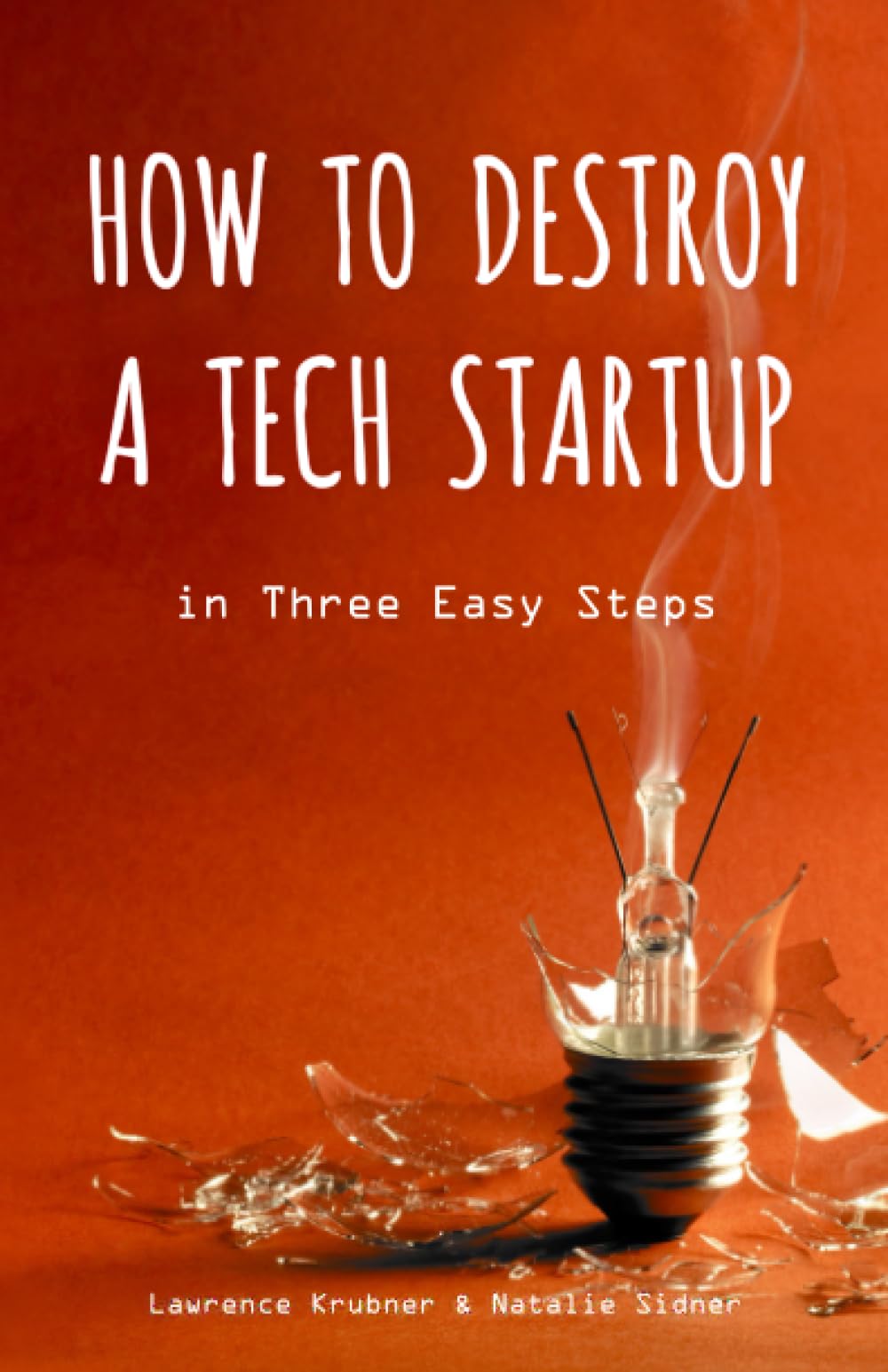
For anyone interested, check out "How To Destroy A Tech Startup In Three Easy Steps":
https://www.amazon.com/Destroy-Tech-Startup-Easy-Steps/dp/09...
https://www.amazon.com/Destroy-Tech-Startup-Easy-Steps/dp/09...
"I could have left Airbnb before things got so bad. But despite all that I observed and experienced, I truly loved my job."
If I love a job, I hesitate to quit just because some of the management is terrible. As a point of reference, many people on Hacker News have read my book "How To Destroy A Tech Startup In Three Easy Steps":
https://www.amazon.com/Destroy-Tech-Startup-Easy-Steps/dp/09...
If you go read the reviews on that book, one of the most common sentiments is "Lawrence should have left that job much earlier than he did." And yet, I really loved the work and I had a lot of fun, in many ways. Maybe I didn't emphasize how much fun we had along the way, but I think, getting to work on great tech while being well paid is a relatively rare gift to an engineer, so I don't think many of us really want to walk away from a job too soon. I do understand why an engineer might stick with a place like AirBnB, even if the burden is heavy.
https://www.youtube.com/watch?v=8znQZ1RUckg
He gave that talk during 2015, the same year that Bill Gates gave the talk about the possibility of a global pandemic. As the article above suggests, Ted Talks were at their peak in 2015, but also TEDx was ruining the brand.
If anyone is curious about my ex-business partner, I talk about him, and my time working with him, in the introduction of How To Destroy A Tech Startup In Three Easy Steps:
https://www.amazon.com/Destroy-Tech-Startup-Easy-Steps/dp/09...
https://www.amazon.com/Destroy-Tech-Startup-Easy-Steps/dp/09...
And yet, the outside agency costs more than actually adding to the headcount, so it is not cost effective. However, it is seen as temporary, so it this strategy is favored. There is the odd fear that headcount is permanent -- a fear that is mildly true in Europe, but definitely not true, at all, in the USA. Yet in the USA I still see managers who are eager to outsource.
The outsourcing tends to become permanent. The idea that it is somehow less permanent than headcount is a pure fiction.
But to the main topic, I appreciate this essay for emphasizing that "People are not fungible." I've tried to emphasize this in my own writing. I think, in general, writing about startups would be healthier and more realistic if we had more case studies that emphasized the role of specific individuals, for good or for bad.
In my own book, How To Destroy A Tech Startup, I tried to emphasize this:
-----------------------------
Emotions matter. We might hope that those in leadership positions possess strength and resilience, but vanity and fragile egos have sabotaged many of the businesses that I've worked with. Defeat is always a possibility, and not everyone finds healthy ways to deal with the stress.
More than once, I’ve seen startups self-destruct.
I'm making a point about the importance of the individual in a small startup. In a large company, an eccentric individual does not do much damage. Even when such a person is in a leadership position, the company will have a bureaucracy that can ensure some stability. But when a company consists of two, or only a few people, and one of them reacts neurotically to challenges, that company is doomed.
I’ll relate one of my previous experiences to illustrate this point. From 2002 to 2008 I spent most of my time working with an entrepreneur who had inherited a few million dollars when he was 25. He managed to burn through much of his legacy in just the time we were colleagues. He admired musicians and considered the music industry glamorous, so he built a sound studio. It never made money. The bands that stopped by were broke. Those few who came up with a hit song mostly signed with a major label which, typically, had its own recording studio.
I met him in 2002 when his focus was shifting to the Web. I had developed some software that allowed people to create weblogs. Typepad.com, which offered something similar to what I'd built, had just raised $23 million in funding. Surely we could do the same?
Working with him was difficult. We might go like maniacs on some project for four months, and when we were on the brink of unveiling it to the public, he would grow bored with it, and move on to something else. The first time this happened, and I asked him his reasons, he improvised some arguments that sounded plausible. Perhaps he suggested there were already too many startups doing the same thing. But this pattern, where he walked away from a project just when we were ready to introduce it to the public, repeated itself. What led to this self-sabotage? As I met his whole family over the years I got to see the sad dynamics that ate at him. He had a desperate need to impress his father. A modest business success would not be enough, in fact, it would leave him embarrassed. Only the creation of something as big as Google would impress his father. But to grow that big, we would first need to be small, and that was the step he had no patience for.
As the years went by, and he burned away all the money he'd inherited, the stress wrecked him. His self-image became increasingly grandiose. He told people that he was a visionary, someone who was able to tell what the future would look like. Late at night he would smoke marijuana and read articles on Slashdot and TechCrunch and then put together an amalgam of words that seemed full of the bright hopes of humanity, which he offered up as our marketing: "The Universe is fundamentally electromagnetic yet non-sentient, and we are sentient but only partly electromagnetic; the Internet is the ultimate harnessing of sentience to the fundamental forces of the Universe. Therefore our software will put you, our customer, in the driver's seat of real-time conscious human evolution." Later, when he wrote up our business plan, he put these two sentences in the Executive Summary. I’m not joking. https://www.amazon.com/Destroy-Tech-Startup-Easy-Steps/dp/09...
Just for a moment, assume there is an abundance of people with interesting ideas that deserve to be pursued, but for some reason these people are being stifled. Why are they being stifled, and are there ways we can better support them, so they can move forward?
On this theme, and speaking of a specific startup where I worked, where some of us were deeply excited about the project, I was recently writing a response to some criticism I received in response to "How To Destroy A Startup In Three Easy Steps":
https://www.amazon.com/Destroy-Tech-Startup-Easy-Steps/dp/09...
In response to the criticism I received, I wrote:
------------------------------
Leimgruber phrased it best, in his review on Amazon, so I quote him here, to answer everyone:
Personally, I find the book most interesting not for the absurdly lousy management characters, but for giving a glimpse into the mind of a person that accepts this kind of treatment as okay, shoulders unreasonable burdens, and seems repeatably drawn into difficult situations with the corresponding drama that inevitably ensues.
This begs the question for me (and likely much of this book's readership):
Why are many talented software developers drawn to solving impossible problems, drinking unhealthy amounts of coffee, neglecting their sleep and personal lives, and constantly trying to fix everthing and everyone around them while ignoring their own psychosocial needs?
To my mind, the interesting question runs in the other direction. Why is bad leadership so common? Why is it so universally accepted? To anyone who suggests that we should quit our jobs after some disagreements with management, I would ask why is it that we need to leave? Why doesn't the leadership leave? Shouldn't management resign, if they are unfit to get the mission done?
Some questions have large implications. Why are so many leaders so completely self-destructive? If Milton had simply been greedy, in a rational way, he would have allowed me to work on the technology that might have eventually generated a lot of money for him. But I find that business leaders are rarely rational. Impulses and ego seem to be the most common forms of decision making. Why is this accepted?
The second comment I'd like to respond to was written by "Antoni" on Goodreads:
I loved the first 80% of it, which is enough to give a positive opinion I guess. What I didn't like really is that the book is written from the perspective of startup employee, not the founder. So there's only part of the story. Only information that the writer assumes. He uses a lot of exaggerations as well that are fun to read and enjoyable but some dialogues are hard to believe to be true.
I would recommend it to people working in tech startups, to feel good about the environment that they work for rather than take some valuable lesson from the book since it's more about management tyranny, mobbing and lack of transparency rather than actual reasons why startup failed from a perspective of a person that had full picture (instead of an employee).
In response, please consider these four ideas:
1.) The failure of any venture is always a complex event, and no one can easily say why it failed. Consider when an airplane crashes, it often takes an army of investigators years to figure out why the accident occurred, even though the investigators are guided by the experience of all previous airplane failures. A startup with an entirely novel idea will be too unique for anyone to easily diagnose its failure. There are too many variables, and too many embedded assumptions.
2.) A good leader over-communicates in a crisis, and every day is a new crisis for a startup. Above all else, the leadership needs to "listen real loud." A startup is either a transparent learning organization or it is dead. Milton's crass hoarding of secrets was a self-inflicted injury. While there might be some other reasons why the startup failed, it is absolutely true that our lack of communication was the starting point of all the other problems that we faced. Since I was central to the technology effort, the startup could only succeed if I was well-informed about our real needs. Keeping me in the dark was a problem for the whole company. I'm confused how anyone could complain that this book is about "lack of transparency rather than the actual reasons why the startup failed." I've tried to be clear about this, but I'll repeat it here again: lack of transparency was one of the reasons why the startup failed. We can debate whether it was the most important factor, but it was obviously a significant factor.
3.) Antoni says they wished the book was told "from the perspective of a person that had the full picture (instead of an employee)." Possibly I failed to emphasize this enough, but no one at Celelot had the full picture. Just like the three blind men in the fable, we were each touching a different part of the elephant, and we were reaching different conclusions about its shape. I was holding onto the technology, so I believed one thing, while Milton was holding onto the sales leads, so he believed something else. This much is completely normal at all businesses, it is a problem with a standard solution: lots of honest communication. Sadly, honesty was lacking. A series of lies were told about the company's finances, so myself and Kwan were constantly guessing at the truth. At some points we felt we were working at a well-capitalized firm, other times we thought the whole place was about to run out of money. But neither Milton nor John knew much about the company, either. At no point did Milton sit down and have a good faith conversation with me about the status of the code at the company. At first I was elated with the level of autonomy I'd been granted, then later I realized that the leadership was operating with assumptions that were out of line with reality. A ship captain who has no idea of their location near the coast is a ship captain who is about to run aground, and likewise, Milton's ignorance of our progress meant the whole company was slipping toward hidden reefs. If Milton were to write a book about Celelot, he could fill in his side of things, but his side of things would not represent the total truth.
4.) We have suffered a glut of books that aim to build a cult of personality around certain entrepreneurs. This tendency has gone furthest with Steve Jobs. What is remarkable is that this trend should get going at a time when innovation from Silicon Valley is clearly decreasing. In his 2006 book, The HP Way, David Packard talks about the process by which he and Bill Hewlett grew Hewlett–Packard. In their rejection of standard corporate hierarchies and their hunger for input from everyone, they were clearly blazing a radically new path in both management style and technology. It is noteworthy that when they were at their most creative, in the 1940s and 1950s and 1960s, no one set out to create a cult of personality around them. In 1968, when Robert Noyce and Gordon Moore founded Intel, no one thought to write them up as heroic characters, but it was in that era that their technology was creating the most profound shifts in industry. At some point after 2000 the rate of innovation in Silicon Valley began to slow, and yet this was the era when the rhetoric about visionary geniuses and innovation began to take on the tone formerly reserved for artists and military conquerors. Real leadership is rare, so we should celebrate it whenever it appears, but we should remember it comes as often from the lower ranks as the upper ranks, so a series of books that only looks at the upper ranks must automatically leave us with a skewed picture of reality. My point is, we need more honesty about what is actually happening in these companies. We need less books written by or about founders, and more books written by those who are in the trenches, working everyday to build something new. Above all else, we need better documentation of the ways that management often sabotages the worker's efforts to invent the future.
----------------------------
A final point for Hacker News to consider: some of these distortions that we are seeing, regarding misalignment of leadership styles, and in particular misalignment between short-term goals and what the team is committed to building, is a political question that very much goes back to the question "Are Ideas Getting Harder to Find?"
Now as always, there are a lot of people with interesting ideas. Are they getting the support they need to move forward with their ideas? Or are they being stifled?
https://www.amazon.com/Destroy-Tech-Startup-Easy-Steps/dp/09...
https://www.amazon.com/Destroy-Tech-Startup-Easy-Steps/dp/09...
https://www.amazon.com/Destroy-Tech-Startup-Easy-Steps/dp/09...
I then made the mistake of thinking that I would also have the same kind of fun as an employee. I became the tech lead at a startup, thinking I would have the kind of freedom that I previously had. This was a mistake. I was very excited about the technology that this startup was working on, but in the end I found, these jobs are much less fun, if you are not the founder, because there is a lot of pressure that comes from up above you, and when you come up with what you think is a great idea, you don't get to implement it. And there are additional frustrations: for instance, on this project I came to believe that it was crucial that we fire our initial data scientist, but the top leadership refused to fire him. This was a major roadblock that I would not have faced if I was the founder, as I would have had the authority to fire someone if I was the founder.
For anyone interested, I wrote in great detail about the experience here:
https://www.amazon.com/Destroy-Tech-Startup-Easy-Steps/dp/09...
https://www.amazon.com/Destroy-Tech-Startup-Easy-Steps/dp/09...
"I mean, essentially it's a command line interface with a wonky input method, no?"
This is precisely the feedback we got from salespeople, when we were working on a Natural Language Programming interface for Salesforce. Initially, I got angry and denied the comparison. But after several people made the same comparison, I came to appreciate how true it was. Unless NLP is perfect, it is really just a Command Line Interface with an awkward input device. I talk about this a little towards the end of this story:
https://www.amazon.com/Destroy-Tech-Startup-Easy-Steps/dp/09...
https://www.amazon.com/Destroy-Tech-Startup-Easy-Steps/dp/09...
https://www.amazon.com/Destroy-Tech-Startup-Easy-Steps/dp/09...
For those interested, I've written about this elsewhere:
-----------------------------
We might hope that those in leadership positions possess strength and resilience, but vanity and fragile egos have sabotaged many of the businesses that I’ve worked with. Defeat is always a possibility, and not everyone finds healthy ways to deal with the stress.
Each person matters. Established firms will have a bureaucracy that can ensure some stability, even when an eccentric individual is in a leadership position, but when a company consists of just two or three people, and one of them reacts neurotically to challenges, the company is doomed.
From 2002 to 2008 I worked with an entrepreneur who had inherited a few million dollars when he was twenty-five. He admired musicians and considered the music industry glamorous, so he built a sound studio. It never made money. The bands that stopped by were broke. Those few who came up with a hit song mostly signed with a major label which, typically, had its own recording studio.
I met him in 2002 when his focus was shifting to the Web. I had developed some software that allowed people to create weblogs. Typepad, which fostered something similar to what I’d built, had just raised $23 million in funding. Surely we could do the same?
Our difficulties were self-imposed. We might go like maniacs on some project for four months, and when we were on the brink of unveiling it to the public, he would grow bored with it and move on to something else. The first time this happened, and I asked him his reasons, he improvised some arguments that sounded plausible; there were already too many startups doing the same thing. But this pattern, where he walked away from a project just when we were ready to introduce it to the public, repeated itself.
What led to this self-sabotage? As I met his whole family over the years I got to see the sad dynamics that ate at him. A modest business success would not be enough, in fact, it would leave him embarrassed. Only the creation of something as big as Google would suffice. But to grow that big, we would first need to be small, and that was the step he had no patience for.
As the years went by and he burned away all the money he’d inherited, the stress wrecked him. His self-image became increasingly grandiose. He told people that he was a visionary, someone who was able to tell what the future would look like. Late at night he would smoke weed and read articles on Slashdot and TechCrunch and then put together an amalgam of words that seemed full of the bright hopes of humanity, which he offered up as our marketing: “The Universe is fundamentally electromagnetic yet non-sentient, and we are sentient but only partly electromagnetic; the Internet is the ultimate harnessing of sentience to the fundamental forces of the Universe. Therefore our software will put you, our customer, in the driver’s seat of real-time conscious human evolution.” Later, when he wrote up our business plan, he put these two sentences in the executive summary. I’m not joking.
We had one modest success, in 2007. His girlfriend, a yoga instructor, suggested we build an online marketplace where yoga instructors could sell videos, as well as other health advice. This site was an immediate success. Within the first month it was profitable. We were written up in all of the major yoga magazines. It seemed obvious to me that we should use the same technology to build a series of similar sites. We could do a site devoted to cooking videos, another devoted to tennis, another devoted to golf. Indeed, just a few years later, the team behind Revolutiongolf.com did exactly what we could have done.
My business partner, however, was enraged by the success of the yoga site. He had burned through several million dollars chasing ideas that he felt were “visionary” and then his girlfriend came up with a simple idea that turned into our one true hit. To this day, it remains a popular yoga site. We could have built an empire around that site, but instead his girlfriend’s success left him bitter.
https://www.amazon.com/Destroy-Tech-Startup-Easy-Steps/dp/09...
--------------------
Tuesday, June 9th, 2015
John told me that the board of directors had drawn up monthly sales goals for him. Starting in August, he would be expected to hit his quota. I thought this was insane. Once a product exists and is stable, then a company can draw up a sales schedule. How can one reasonably do that when the product does not even exist yet? Especially if the product is a cutting-edge technology which carries a lot of unknowns? For a stable company with an existing product, deadlines need to be more than mere aspirational goals, but when building truly original technology, then the entire company is aspirational — until the technology is working, there is no proof that the technology can work.
Even if the glorious day arrived when we would finally have an app customers could install on their iPhones, that would only be the beginning of a long process. Customers are an endless surprise. I’ve worked with startups for sixteen years; I know this well. Whenever I have shown people new software, the features that seemed intuitive to me were counterintuitive to them. Real-life needs that seemed intuitive to them seemed strange to me. If John thought that we could create our apps and have them working by mid-August, and he could immediately go out and start making tons of money, then he was sadly mistaken. If the board of directors thought that, then they were being badly misled.
https://www.amazon.com/Destroy-Tech-Startup-Easy-Steps/dp/09...
When you have a bad project manager, good software will not save you. This is my personal story of how things can go wrong:
-----------------------------------
At 2 PM we had a meeting scheduled to go over all of the tasks in PivotalTracker. John had promised Milburn that we would execute our work according to a project-management philosophy that the tech industry called agile. Agile software development, among many other aspects, focuses on the delivery of small, incremental improvements to software. It encourages self-organizing teams, evolving and continuous progress, and rapid response to challenges faced. The Celolot team would work two-week sprints, checking in at the end of each period to see where everyone was at.
Unfortunately, vague definitions of “done” haunted our progress. John read through a long list of tasks that had been assigned to Sital.
“Find all possible variations of ‘Close Date,’” John read from the screen. “Is this done?”
“Yeah,” muttered Sital. “Sure.”
His assurance meant nothing to me. Sital would never lie, indeed I was often surprised by his childlike honesty, but he lacked an appreciation for the many ways that software could break.
“How many variations have been tested?” I asked.
“Two,” replied Sital.
“That’s not enough,” I said.
“That’s enough,” countered John. “‘Close Date’ and ‘Contract.’ That’s all we need.”
“What about ‘Close’?” I asked.
“Oh, yeah,” John thought aloud. “What about ‘Close’?”
“I’ll see,” Sital responded somewhat robotically.
John marked it as done.
“Wait,” I objected. “That is not done.”
John turned back to Sital. “Do you think you can finish today?”
“Absolutely,” Sital assured us.
“Then I’ll mark it as done,” said John, returning to his screen.
“But it’s not done till it’s done,” I argued.
John pondered this for a brief moment. “It’ll be done today,” he shrugged. He marked it as done.
In my view, John’s casual use of the word “done” to refer to items that were nowhere near done meant that this whole effort to track tasks was a useless ceremony. But John felt good about it. He could tell Milburn that we were following a two-week sprint, just like an authentic agile team.
It was true we had the accoutrements of an agile team. We used PivotalTracker. We broke down goals into fine-grained tasks. We reviewed the task list once a week, and we added more tasks every two weeks. But the whole thing was mockery of what the Agile Process was supposed to accomplish. If you have programmers who cannot finish assignments, then there is no point in pretending to be making progress.
----------------------
related to here:
https://www.amazon.com/Destroy-Tech-Startup-Easy-Steps/dp/09...
Sturgeon's Law says that 90% of everything is crud, and that applies to startups. The good ones are rare. If you get a chance to work at one of the good ones, you should go for it. But can you be sure? Sometimes the founders are talented at selling a false image of what the project will entail.
Startups are a chance to build something entirely original with brilliant and ambitious people. But startups are also dangerous. Limited money means there is little room for mistakes. One bad decision can mean bankruptcy. The potential payoff attracts capital, which in turn attracts scam artists. The unscrupulous often lack the skills needed to succeed, but sometimes they are smart enough to trick investors. Even entrepreneurs who start with a strong moral compass can find that the threat of failure unmoors their ethics from their ambition. Emotions matter. We might hope that those in leadership positions possess strength and resilience, but vanity and fragile egos have sabotaged many of the businesses that I’ve worked with. Defeat is always a possibility, and not everyone finds healthy ways to deal with the stress.
As an example of what can go wrong, see here:
https://www.amazon.com/Destroy-Tech-Startup-Easy-Steps/dp/09...
https://www.amazon.com/Destroy-Tech-Startup-Easy-Steps/dp/09...
----------------------------
Every industry has certain euphemisms for the least savory aspects of its business. In sales, there is the secretly ugly phrase, “goal-oriented.” That sounds pleasant, doesn’t it? If I point at a woman and I say, “That entrepreneur is goal-oriented,” then you probably think I am complimenting her. But if I point at her and say, “That entrepreneur is a lying, manipulative, soulless psychopath who brutally exploits labor from the eleven-year-olds she employs in her sweatshops in Indonesia,” then you probably think I am insulting her, unless you are a libertarian. And yet both statements mean about the same thing: that she is someone who is willing to do whatever is necessary to ensure the success of her business.
When I read about Milburn online, I’d seen testimonials from his colleagues in which he was often described as a goal-oriented salesperson. That probably meant that he was a master of manipulating other people’s emotions. He knew all the tricks: praise, shame, laughter, anger, promises, guilt, threats.
Whether his use of these tools was conscious or unconscious is, of course, unknowable. But it doesn’t matter much. A lifetime as a sales professional left him with an arsenal of psychological ploys that had become second nature to him.
...Milburn truly had a genius for the strategic use of anger. If he sensed the risk of losing control of the conversation, he would indulge in another outburst. If I were to ever switch over to the Dark Side, I would want to study with him. His techniques were fundamentally dishonest and manipulative, but that is probably what made him so good at sales. And his tactics were probably an effective way to drive a sales team, but I sincerely believed that such tactics were the wrong way to run a software development team. Especially when doing something cutting-edge original, like we were doing, I think open and honest communications were extremely important. (I have worked with many companies where the sales team was both friendly and successful. One does not need to use abusive tactics to have success in sales. Indeed, the sales manager who relies on abuse is typically more interested in aggrandizing their own success, rather than the success of the company they work for.)
https://www.amazon.com/Destroy-Tech-Startup-Easy-Steps/dp/09...
----------------------------
Recently, I exchanged some email with my friend Colin Steele, currently CTO of TypeZero and formerly CTO of RoomKey.com. We discussed another startup that had failed, and he wrote:
It’s sad and disheartening. I think few people understand how amazingly difficult it is to start a new business, and run it successfully. Drama, people, and personalities, seem to have an outsized role in how these things crash and burn. There needs to be some codification of best internal practices for creating startups, like Steve Blank’s book “4 Steps To The Epiphany,” but for the culture; a co-routine that runs alongside “customer development” — call it “culture development” or something.
I agree wholeheartedly, and would also add that more public discussion of the difficulties would help startup culture. I would make an analogy to the history of divorce in the United States. The divorce rate rose for much of the twentieth century, and it peaked in the 1970s and 1980s. Since then there has been more public discussion about what makes marriages strong. You can see the trend reflected on television shows: neither Leave It To Beaver nor the Brady Bunch mentioned the difficulties of marriage, and that was the era when the divorce rate was rising the most. Modern sitcoms talk endlessly about the difficulties of marriage. Couples still face drama and conflict and personality, but the public discussion seems to have granted people the vocabulary they need to address their problems, and the divorce rate has come down. Popular awareness helps. At the very least, books and movies can help explore the important reality that startups are not easy.
https://www.amazon.com/Destroy-Tech-Startup-Easy-Steps/dp/09...
https://www.amazon.com/Destroy-Tech-Startup-Easy-Steps/dp/09...
That is the flip side of it. Endlessly shouting "Express yourself and amazing things will happen!" is a bit of a trap. It doesn't prepare kids to handle the lucky breaks that some of them will undoubtedly get.
https://www.amazon.com/Destroy-Tech-Startup-Easy-Steps/dp/09...
If a programmer has a habit of sloppy code, or violates the team's standards in some ways, then a good leader will keep track of the fact that one person is responsible for a recurring pattern of mistakes.
I absolutely agree with Rachel By The Bay, that many bugs arise from the complexity of the situation, and it would be wrong to blame the person who just happens to trip over that bug. But a good leader should take action against anyone who repeatedly screws up, and who seems unwilling to improve.
I've written about this before. This is from "How To Destroy A Tech Startup In Three Easy Steps":
----------------------
Wednesday, July 15th, 2015
I got to work at 11:00 a.m. John announced that our demo had stopped working. Sipping my coffee, I logged into the server to find out what the problem was. I looked at the error log for the API app, but it seemed okay. Then I checked the error log for the NLP app.
java.lang.StringIndexOutOfBoundsException: String index out of range: -1 at java.lang.String.substring(String.java:1955) at Celolot.nlp.Extractor.fuckBitchesGetMoney.java:87
What the hell was this?
“FuckBitchesGetMoney”?
What kind of name is that for a function?
A computer programmer can name their functions anything, but there are some “best practices” regarding names, and this particular function name violated all of them.
I asked Sital why he had given this name to his function. He looked at me straight, shrugged, and stated that the name was from the 1995 song by The Notorious B.I.G., “Get Money.” I replied that rap lyrics were not part of our naming conventions. He promised that he would change it.
Coming from anyone else, I might have interpreted the function name as an act of angry rebellion, but Sital was too forthright for that. Apparently, he thought the name was funny and went with it because he wanted to add some humor to his code. Never did he stop to think it might be unprofessional.
I looked through his code and found several other functions that had inappropriate names. I sent him a list and asked him to change their names to something standard.
A week later the function was still there. FuckBitchesGetMoney. Yet I don’t think that any of this was a deliberate act of rebellion. He was just oddly forgetful and disorganized.
https://www.amazon.com/Destroy-Tech-Startup-Easy-Steps/dp/09...
https://news.ycombinator.com/item?id=16561764
And the book:
How to Destroy a Tech Startup in 3 Easy Steps
https://www.amazon.com/Destroy-Tech-Startup-Easy-Steps/dp/09...
Most of us simply skip over the stuff that doesn't interest us. That is clearly the default behavior. Therefore it is interesting why, on certain articles, people do feel the need to comment on the style.
Personally, I've been lucky, because the most vocal people have been the people who like my writing. But not always. I wrote a book about startups, and some people loved that it had a lot of humor, whereas others really hated it. At least so far, the one's who hate it write to me privately, whereas the ones who love it have written the reviews on Amazon:
https://www.amazon.com/Destroy-Tech-Startup-Easy-Steps/dp/09...
I'm lucky, but I'm also curious why this is. As a purely sociological question, why is that sometimes people feel the need to be very vocal with their disapproval, whereas most of the time they keep such disapproval private?
Excerpt from a real life situation I was in:
===========================
June of 2015:
Sital was a beginner. In general, there is nothing wrong with being a beginner. All of us are beginners at some point. And for the most part, I think corporations in the USA can do more facilitate apprenticeships to help people start their careers. However, we were a startup that needed to move fast. Could we succeed when we had a beginner in a critical role? I had doubts.
July of 2015:
I felt no sympathy for John. Hiring Sital had been his call, as was failing to hire Arthur. These last few weeks had offered plenty of evidence that Sital was a liability to the team. If John wanted to stick with Sital, he would have to live with the consequences.
I would feel very differently if Celolot had a formal commitment to an apprenticeship program, and if I had clearly been given the responsibility of running that program. And I do think corporations in the USA can do more to help people start their careers. But it was ridiculous to both want to run an aggressive schedule and also train a beginner. The one contradicts the other.
https://www.amazon.com/Destroy-Tech-Startup-Easy-Steps/dp/09...
This has been discussed on Hacker News before, but again, here are a few brief excerpts about how this relationship fell apart at a startup where I was at in 2015:
July of 2015
...All the same, a wave euphoria swept over John, which he communicated to the Board Of Directors. Much later, I learned that at this time they began to schedule their plans around the assumption that we'd be making significant money by September. Again, though I can admire a sales team that aims to hit aggressive targets, making such plans around a product that doesn’t yet exist, and which seems to be running behind schedule, is delusional.
August of 2015
...But Twilio would be a very dangerous step for us. If John and the Celolot Board of Directors really wanted us to ditch our iPhone app, this meant that we would be 100% committing ourselves to English as our only interface — and building a flawless NLP engine would be indispensable. There would be no buttons, no forms, nothing to click on. Just words and phrases written in English, submitted by innumerable users. And if we failed to build an NLP engine that could understand all of it, then we were doomed. I thought NLP was a fantastic supplement to traditional interfaces, but as a complete replacement, it was a huge gamble. It was like jumping out of an airplane without a spare parachute. Furthermore, if we had Hwan build us an app, then we could customize it in some really cool ways. Special messages, special ways of allowing data to be edited – things that are not possible with the standard iPhone Message app.
September of 2015
..."I am asking a hypothetical question." I thought this was obvious, but I was willing to emphasize the fictional nature of the scenario if it would calm him down.
"But why would you ask that?" The intensity of his reaction was as if I’d just asked him something obscene.
"Because I think hypothetical questions are important."
"I don't! I think working is important! Let's work hard and get this software running!"
"I’m sure we’ll get it working at some point, but we have already seen many unexpected delays." I pointed this out as calmly as I possibly could. "What if we encounter another?"
"If we miss this deadline, I'm going to ask you to talk to Milburn [of the Board]."
He threatened this as if it were the worst punishment he could imagine inflicting on me. Like, if the prisoner does not break during waterboarding, then we have them talk to Milburn.
"You don’t want to talk to him?" I treaded carefully. "You talk to him every day."
"No, you can talk to him about this."
I was wary. It sounded a lot like I was being set up to take the fall for John's bad decisions. A part of me very much wanted to talk to the board, just to be sure they understood the real situation. I wanted to warn them about Sital. I wanted to impress upon them the absolute urgency of the Conversation FSM. But I didn't want my first real conversation with Milburn to be dominated by the question, "Why are you running late?"
==========================
excerpted from here:
https://www.amazon.com/Destroy-Tech-Startup-Easy-Steps/dp/09...
"It was easy for M’s leaders to win internal support and resources for the project in 2015, when chatbots felt novel and full of possibility."
Chatbots were new in 2015? I think it might be more accurate to say they were new in the early 1990s, but they had a revival of interest around 2015, driven by the possibility that advances in AI and NLP would allow them to do more.
One place where chatbots still have a large opportunity in front of them is in automobiles. The driver is not suppose to hold their cell phone while driving. But they can talk to the phone, and voice-to-text allows them to interact with chatbots. Someone in the industry told me that Toyota has inked a deal with Pandorabots:
Likewise, during and after my time at Celelot [1], I talked to a lot of salespeople, and they told me that was the #1 thing they'd like to see, as an interface for SalesForce. They wanted to be able to meet a client, make a sale, and then drive home, and while they were driving, they could talk to their cell phone and the Celelot service would put all the data into SalesForce for them.
[1] https://www.amazon.com/Destroy-Tech-Startup-Easy-Steps/dp/09...
https://news.ycombinator.com/item?id=10876409
It's also disappointing how much of this system remains vaporware:
https://www.theverge.com/2016/1/7/10719202/amazon-alexa-ces-...
It's also disappointing that Amazon continues to resist the changes necessary to make the Alexa a good Enterprise eco-system:
http://www.smashcompany.com/business/the-amazon-echo-will-pr...
On this last point, it is frustrating that we have not seen more competition. Most startups lack the resources to build their own voice system, so they want to build on the back of service being offered by Amazon or Apple or ...
Apple promised to open Siri, but so far you can't build Enterprise apps with Siri.
There is interest among managers. Among the ideas that business leaders have asked me about:
1. An Amazon Alexa in every hotel room, ready to answer guests questions
2. A salesperson leaves a meeting where they made a sale. They get in their car and drive home. They talk to their ______ device and all of the data is sent to Salesforce, the app creating a new Opportunity or new Tasks.
3. An Amazon Alexa skill that can reach into the companies Salesforce account and generate a report for high level executives
Of this last one, we had a working demo in early 2016, but we need some extra tools for specifying the phonetic sound of a company name, as Alexa mangles the names of companies such as IBM and CNET.
As to #2, we worked on a text interface for Salesforce in 2015. I wrote about that extensively here:
https://www.amazon.com/Destroy-Tech-Startup-Easy-Steps/dp/09...
We then investigated how to do this with voice. At the moment, it seems the best option is to use voice-to-text on an iPhone or Android. It's an open question whether it is best to use IBM Watson's NLP tools or build a specialized tool just for dealing with Salesforce.
"No. Just no. Please stop spreading FUD like it's candy. Git only deletes commits after a GC, which won't erase commits from reflog and will keep unreferenced commits for at least a month before deleting them."
It is frustrating that you continue to take your advanced skills for granted. It is frustrating that you can not see what should be an obvious fact: that your skills are above average and therefore it is a mathematical fact that most people have less skill than you, and their lack of skill is a real world business situation that needs to be dealt with realistically. And more so, for the rest of your career your skills will continue to develop, so the gap between you and the average will continue to grow, and therefore the damage that you can do will continue to grow, if you fail to recognize that you are above average.
I can assure that I've seen data lost forever because of "git rebase". It doesn't matter that someone with your skills could have saved the situation. You were not there, therefore your skills don't matter! It is very important that you see this, or you will never be able to give accurate advice to business leaders.
If the leadership of a company decided to hire people with a skill level of x, then they should not also use a technology that requires a skill level of x + 1. You can reasonably tell them "For what you are trying to do, you should hire people with a skill level of x + 1." That is exactly what I did in the situation that I describe here:
https://www.amazon.com/Destroy-Tech-Startup-Easy-Steps/dp/09...
But sometimes the business leadership will disagree with you. They may have terrible reasons, but if you can not get them to change their minds, then you need to deal with the consequences of their bad decisions. At which point it makes sense to advocate for a technology that only requires a skill level of x.
[ EDIT TO ADD ]
I'll point out that you are demonstrating a classic case of the Dunning–Kruger effect. In particular:
"the miscalibration of the highly competent stems from an error about others."
That is, you have above average IQ and skill, therefore you perceive things to be easy, which are in fact not easy for the average.
https://en.wikipedia.org/wiki/Dunning%E2%80%93Kruger_effect
You are an elite programmer. Try to avoid acting like the kind elite programmer that I criticized in "Business productivity has been undermined by the hubris and power-grabbing of elite computer programmers".
You setting your theory against my lived experience. If you want to understand the situation more fully, you can read How To Destroy A Tech Startup In Three Easy Steps:
https://www.amazon.com/Destroy-Tech-Startup-Easy-Steps/dp/09...
I did my best to re-create the extent to which decisions were driven by panic and the pressure of time.
Please note, every company in the world has a finite amount of time, and a finite amount of money. You can argue that a company should hire people with more experience, but people with more experience will be more expensive, so you will end up with less people. Or you can argue that a company should hire more people, of less experience, and then train them. Training takes time, so in this case you are trading time for money.
All of these strategies work, but in different circumstances. In the circumstances that I faced in 2015, described in the book, I advocated for the strategy of less people, of a higher skill level. I was, however, outvoted, which is a reality of corporate life.
It is relatively rare that a company follows an ideal strategy. What I see instead is constant course correction, often with a bit of a lag, so that the company ends up having the ideal strategy for dealing with the situation that it faced 6 months ago, which is not necessarily the ideal strategy for what it is facing now.
Business tends to be chaotic. The Platonic Ideal of computer programming needs to be adjust to the real realities that businesses face.
To be clear, Sital's attitude was a major problem, and myself and co-workers advocated that he be fired. But management kept him on, and I was given the responsibility of covering for the gaps in his knowledge. I was not happy about this, but this is a reality of business: we often have to accept that a decision has been made that we strongly disagree with, and then we need to somehow make the best of it.
May of 2015: hired at startup that wants to use Natural Language Processing so salespeople can send text messages directly to their CRM (Salesforce, PipeDrive, etc). Very excited about the project. The app's initial UI design is a traditional one, with NLP helping to smooth the basic task. The full app would take about a year to build but we all agreed we could have an MVP by August.
August of 2015: without consulting anyone on the tech team, the Board Of Directors decides the app should get rid of all standard UI elements: no forms, no buttons, no links, no drop down menus. Instead, the interface should be a pure chat app. This makes the project much more ambitious, which I was very excited about, but which I felt would delay the project 2 or 3 months. Nobody was happy with my estimate.
September of 2015: the CEO was able to show a demo to the Board Of Directors. The demo was an illusion, as we had no error handling, and it only worked for some carefully planned examples, but I thought it was a good sign that we could show the Board that we were making progress. Unknown to me, the Board then asked the CEO for real feedback from real customers at the next meeting, a month later, in October. There was no possible way for us to finish the product, and find customers, and get feedback, all in a month, but the CEO was a bit of a coward, so he promised the Board we would do this.
October of 2015: obviously we did not have customer feedback by the next meeting of the Board. At this point the Board decides we have missed our schedule and they begin to panic. We are slowed by the fact that our "NLP expert" is inexperienced. Myself and our iPhone programmer tell management that we need to fire the current NLP guy and hire someone with real experience. Management initially agrees but then later changes its mind, for reasons unstated.
November of 2015: we get a basic demo working, and it has enough error checking that we can show it to potential customers, and not be entirely embarrassed. But the stress of the previous month has wrecked relationships inside the company, people are shouting at each other constantly. At this point I step away from the project, but I remain on friendly terms with the guy who is doing the iPhone programming.
January of 2016: company gets two trial customers, but these customers won't pay for the product. The NLP engine is improving, but at glacial speed, as the "NLP expert" is at the beginning of his career. He was a nice person, and I can believe he will eventually become a good programmer, but it didn't make sense that a company that wanted to move fast also remained so loyal to a guy who could not do what was needed. An established company could/should afford to have an apprenticeship program, but a fast moving startup can not offer an apprenticeship to someone working on a core technology.
April of 2016: the iPhone guy again asks management to find a new NLP expert, someone who can move the company forward. Management reacts by listing every bug ever discovered in the iPhone app, as a way of telling the iPhone guy to shut up.
May of 2016: the iPhone programmer quits and gets a job elsewhere.
June of 2016: the company is almost out of money, so it cuts back on spending, reduces the team.
summer and autumn of 2016: without much staff, the company crawls along at a glacial pace
Early 2017: the company gets more funding, begins moving forward again.
Summer of 2017: the company now has a few trial customers, but they are paying trial rates, which is to say, almost nothing. The company is not anywhere close to the breakeven point.
The company continues to burn money without making much progress. There are clearly some fundamental leadership issues that should be addressed, and one of those are the ways that estimates and budgets are created. Also, the company would be in much better shape if the leadership listened to feedback from the tech team.
I wrote about all of this in detail here:
https://www.amazon.com/Destroy-Tech-Startup-Easy-Steps/dp/09...
Get the best books from Hacker News each week
Join 4,500+ subscribers and get the best books mentioned on Hacker News every Thursday.

Up to a point, I can admire the product discipline that Amazon and Apple (Alexa and Siri) have shown in keeping their voice products focused on consumers. But after so many years, when do we finally get voice for the enterprise? At one time, I was very hopeful about this space, see: "I believe in Enterprise software for the Amazon Echo"
http://www.smashcompany.com/business/i-believe-in-enterprise...
In late 2015 and early 2016 this space, of voice tools, was moving quickly and I thought that surely, within a year, we would see better support for enterprise applications. I was mistaken.
Here is an example of the excitement of those times: "Invoxia will allow Alexa to figure out who is speaking"
http://www.smashcompany.com/technology/invoxia-will-allow-al...
At that time, it felt like we were on the cusp of using voice tools in business. There was certainly a market. For instance, https://www.jwt.com/history/ has about 9,000 employees in at least a dozen countries. They reached out to me to talk about their "Pangea" project, which was a huge internal project to better map what teams and skills and resources they had internally. I had a meeting with them in the summer of 2016 and they asked "We are thinking we could put an Amazon Alexa in every meeting room, and then whenever we need someone with a specific skill, we could ask, hey, Alexa, do we have someone at this company who has this skill?"
At that time, I told them of some of the difficulties, but I was also hopeful that things would change a lot of over the next year. I was wrong.
Among the many, many problems we faced was simply getting Alexa to recognize the names of companies, when the sound of the name did not match a standard English spelling:
TATCHA
L’Oréal
L’OCCITANE
What was needed was a way train specific conversions of phonemes to text, for both Alexa and Siri. There are a small number of tricks that are available, such as programming a glottal stop:
http://www.smashcompany.com/technology/using-a-glottal-stop-...
However, in general, neither Amazon nor Apple wants to give us the tools we need, and there has been little progress in recent years.
I know that many people on Hacker News have read my book "How To Destroy A Tech Startup In Three Easy Steps" in which we were using NLP technologies to try to allow salespeople to send text messages to Salesforce:
https://www.amazon.com/dp/0998997617?psc=1&ref=ppx_yo2ov_dt_...
As you can imagine, we hoped to move on to voice-to-text so that salespeople could simply talk to Salesforce.
It seems to me there is a wave of new startups that are waiting to move forward in this area, but no small startup has the resources to build a voice-to-text system from scratch. We need the larger firms to help set up the ecosystem, so that we can move forward in this area.
Where is the company that is going to give us the tools we need to start building great voice driven enterprise solutions?