An information good is one for which it's very cheap to produce additional units. Unfortunately, I'm probably abusing the term, since books are listed as an example of information goods. The idea is that most of the cost of producing the book goes into the content (writing, editing, etc.) and actually printing one additional book is cheap. (When I said books are "imperfect" information goods I meant that they still require paper and shipping and retailing and such, but it's probably just a bad use of the term.)
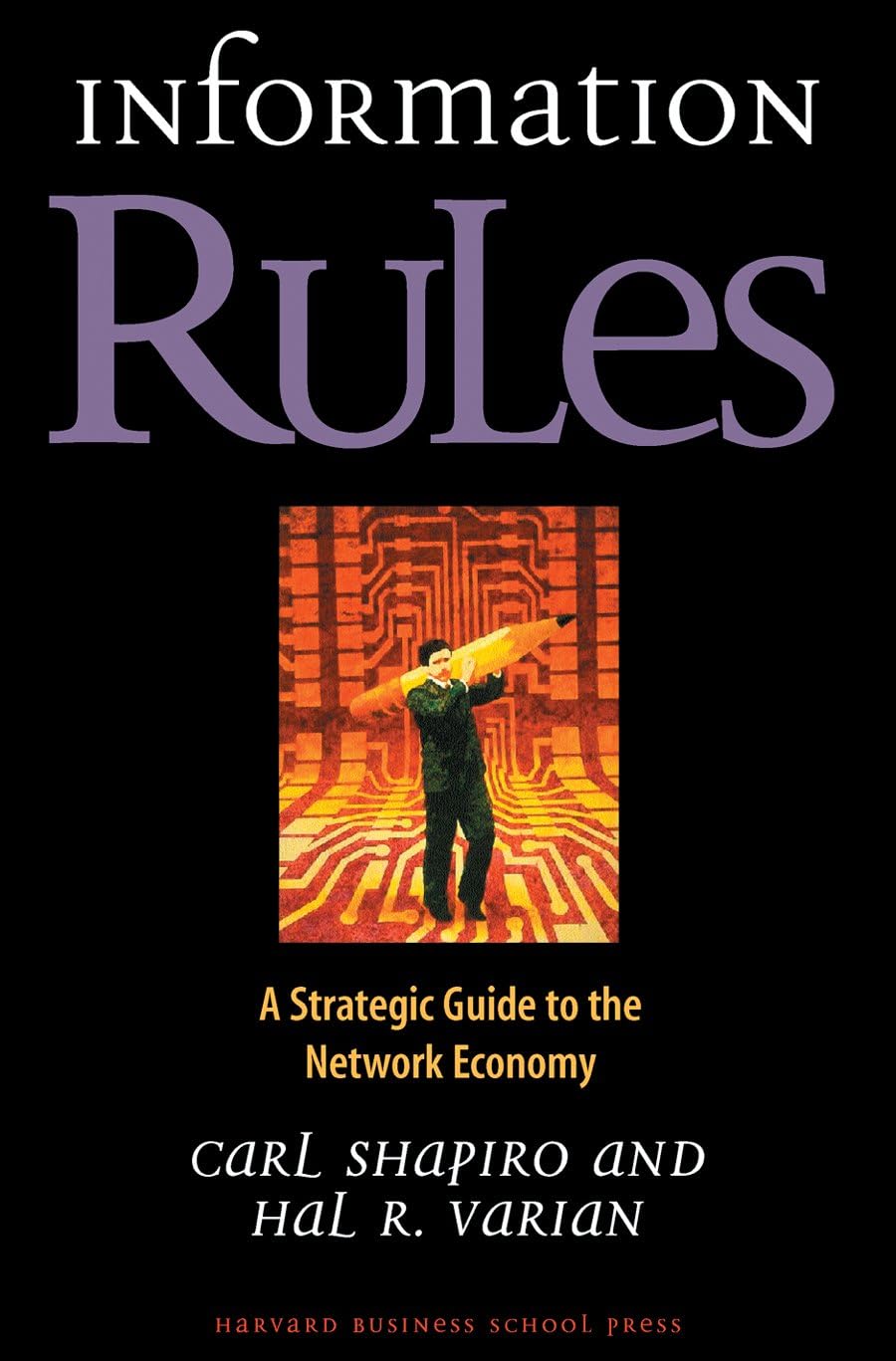
There's a fantastic book about the economics of information goods called "Information Rules" ( https://www.amazon.com/dp/087584863X ). Software is an information good so this covers some topics relevant to the digital economy. My favorite part is the chapter on lock-in. In particular the discussion around the equation:
profits from a customer = quality advantage + switching costs
which puts "(marginal) goodness of your product" on equal footing with "pain you can inflict on your customer for leaving".
http://www.amazon.com/Information-Rules-Strategic-Network-Ec...
One of the authors is now the chief economist at Google. I highly recommend it.
http://www.amazon.com/Information-Rules-Strategic-Network-Ec...
In the late 1990s and early 2000s, economists really began to look at the Internet (Hal Varian, Google's Chief Economist is probably the best example -- see his 1998 book "Information Rules"[3]). They tried to tackle issues like price dispersion in a homogeneous goods market on the Internet (that is, why does price dispersion still exist in an Internet market for a homogeneous good?) and other problems of consumer information heterogeneity, consumer search, and so on. Starting in early 2000, economists began to take interest to the "gatekeeper" model of Internet prices -- a website that would aggregate prices across online retail sites. "If a consumer just has to go to one site to become informed about all the prices in the market, then consumers can costlessly become informed about all the prices in the market by going to the gatekeepers site" many microeconomists said. This led many researchers to look into the model of fees charged by gatekeepers to retailers who wanted to have their prices posted on the site.
Eventually, Tirole et al realized a way to generalize the concept of a two-sided market by describing it as a platform where the owner of the platform receives revenue from two [or more] sources (i.e. buyers via advertising and sellers via gatekeeper fees), hence making the general distinction between a multi-sided market and the the classic supply/demand market model. Today multi-sided markets are used to model almost all forms of platform competition.
From my perspective, research on the economics of the Internet hit a bit of a slump in the late 2000s as [too] many economists instead focused on macroeconomic issues during the bubble, but has grown in interest quite a bit again over the last 3-5 years with the rise of social networking and similar app/mobile platforms. So much of this research relies on fundamental models of two-sided markets, that I encourage anyone curious about really hot microeconomic theory topics related to the Internet and start-up industry to dig into platform competition.
[1] Platform Competition in Two-Sided Markets, http://ideas.repec.org/p/ide/wpaper/654.html
[2] Information Gatekeepers on the Internet and the Competitiveness of Homogeneous Product Markets, http://papers.ssrn.com/sol3/papers.cfm?abstract_id=215548
[3] Information Rules, http://www.amazon.com/gp/product/087584863X/
Get the best books from Hacker News each week
Join 4,500+ subscribers and get the best books mentioned on Hacker News every Thursday.

https://www.amazon.com/Information-Rules-Strategic-Network-E...
I know it may sound not helpful but achieving vendor independence is a valid reason for adopting at least some software design patterns so you can swap the implementations without changing the interface. It’s becoming increasingly more important as the cloud service providers are getting more aggressive just because they can get away with it.