https://www.amazon.com/Managing-Humans-Humorous-Software-Eng...
https://www.amazon.com/Managing-Humans-Humorous-Software-Eng...
http://www.amazon.com/Managing-Humans-Humorous-Software-Engi...
1-1s are probably your most valuable tool. Often, you will discover problems and info you would have otherwise not known - "our lead developer seems depressed and was talking about quitting", "did you hear about that other project that started? It's in direct conflict with our plans...", "there's a conference coming up, we should present at it", and so forth.
An effective manager should, in my opinion, spend 50% or more of his time with his team. Working on the same topics, talking to them, helping to plan, fixing problems, finding resources, and doing 1-1s. It's no surprise that teams with the most problems often have a manager who is just not around enough.
For new managers, I always suggest the following resources as a great starting point:
- "Team Geek": http://shop.oreilly.com/product/0636920018025.do - "Managing Humans": http://www.amazon.com/Managing-Humans-Humorous-Software-Engi... - Manager Tools podcast: https://www.manager-tools.com
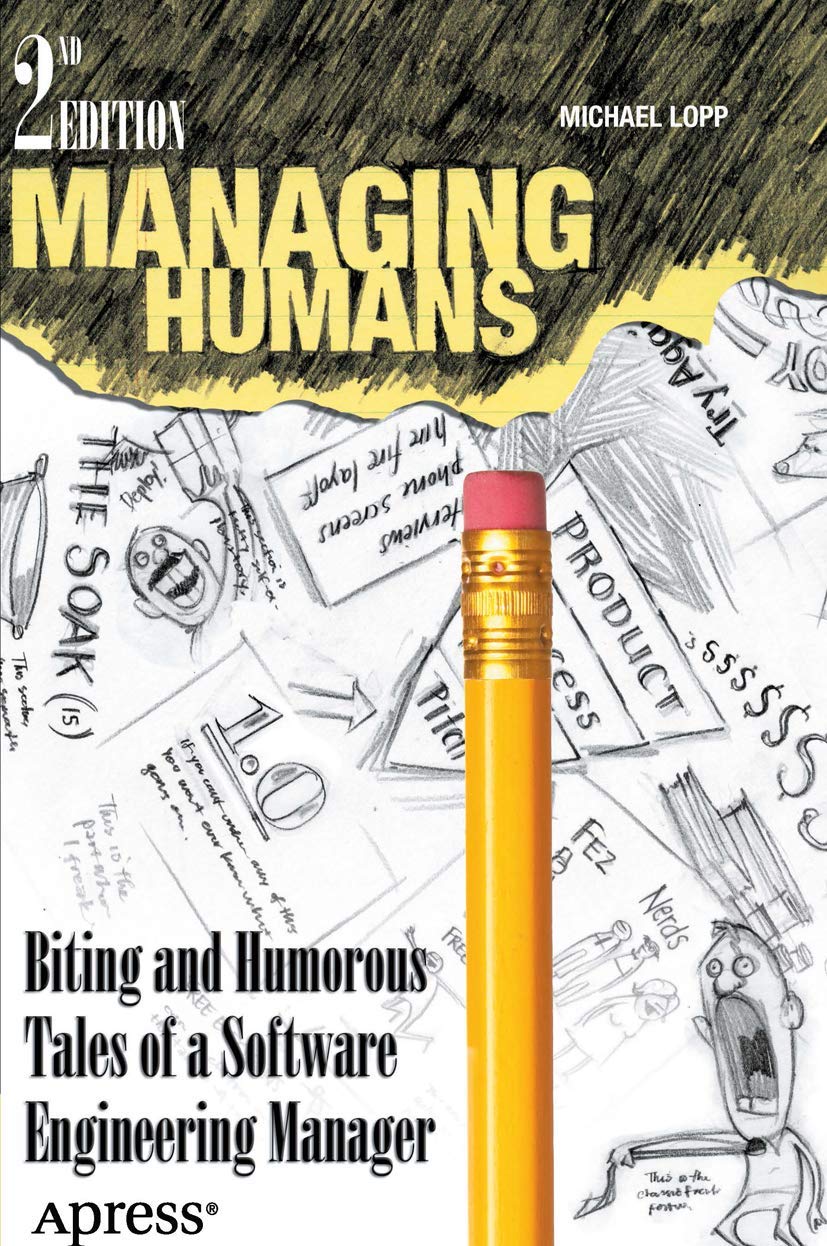
At the top of the list is "Managing Humans: Biting and Humorous Tales of a Software Engineering Manager" by Michael Lopp[1], which was recommended to me by a manager who helped me get my start in engineering management. This book touches on a lot of the nuances in dealing with people and, as an introvert, I found this really helpful. The same author blogs under "Rands in Repose[2]" which has much of the content from the aforementioned book available for free.
While in the people category you'll also get a lot of recommendations for "Drive!" by Daniel Pink[2], which is a book about intrinsic motivators (autonomy, mastery, purpose) and how they are more important and effective than extrinsic motivators (e.g. money), particularly for knowledge workers. My personal advice, however, is to watch his TED talk[3] which is a great summary of basically the entire book. In this same category I could also recommend "The Great Jackass Fallacy" by Harry Levinson[5].
Now on the wall between people management and engineering/project management is "Slack" by Tom DeMarco[6], which is about how organizations and managers tend to run their staff at 100% capacity. As the book points out, however, this is a good way to not only burn people out, but it also sends response times through the roof (from queuing theory), and stifles change ("too busy to improve"). You can read this one on a plane. For some shameless self promotion, I've also written a tiny blog post relating Slack and the need for upkeep (software operations and maintenance)[7].
Next, fully in engineering/project management, I have to recommend "Waltzing with Bears" by Tom DeMarco and Anthony Lister[8], which is specifically about managing risk on software projects. The authors highlight the common practice of project/engineering managers communicating their "nano date", which they point out is typically the lowest point on the uncertainty curve. In other words, the project has the lowest possible chance of shipping by this date when you look at the possible timeline as a probability distribution. This book changed the way I talk about projects and the way I manage my team's various risks and I have been more successful as a result.
One final recommendation I'll make, since you're in the midst of a transition, is "The First 90 Days" by Michael Watkins[9]. It's a wonderful book that outlines how and why one should develop a transition plan in order to hit the ground running - and in the right direction. For my last engineering management opportunity, developing a preliminary 90 day plan as part of a "starter project," was a major factor in being given the job.
I believe that a subset of these will give you a great start. After that, you should read on the areas you feel the need for the most amount of help with or the areas that interest you. If you are avidly interested in project management, for example, you should read books on various methodologies, particularly the one that you or your organization practice.
[1]: http://www.amazon.com/Managing-Humans-Humorous-Software-Engi...
[2]: http://randsinrepose.com/
[3]: http://www.amazon.com/Drive-Surprising-Truth-About-Motivates...
[4]: http://www.ted.com/talks/dan_pink_on_motivation?language=en
[5]: http://www.amazon.com/Great-Jackass-Fallacy-Harry-Levinson/d...
[6]: http://www.amazon.com/Slack-Getting-Burnout-Busywork-Efficie...
[7]: http://www.charleshooper.net/blog/on-slack-and-upkeep/
[8]: http://www.amazon.com/Waltzing-Bears-Managing-Software-Proje...
[9]: http://www.amazon.com/The-First-90-Days-Strategies/dp/159139...
The reality of people management is that books and articles will only take you so far. They can build a good foundation, but nothing cements the lessons like making mistakes, recovering from them, and learning how to avoid them in the future. Keep an open mind, don't be afraid to experiment, and look out for your team. Everything else will come through experience.
Get the best books from Hacker News each week
Join 4,500+ subscribers and get the best books mentioned on Hacker News every Thursday.