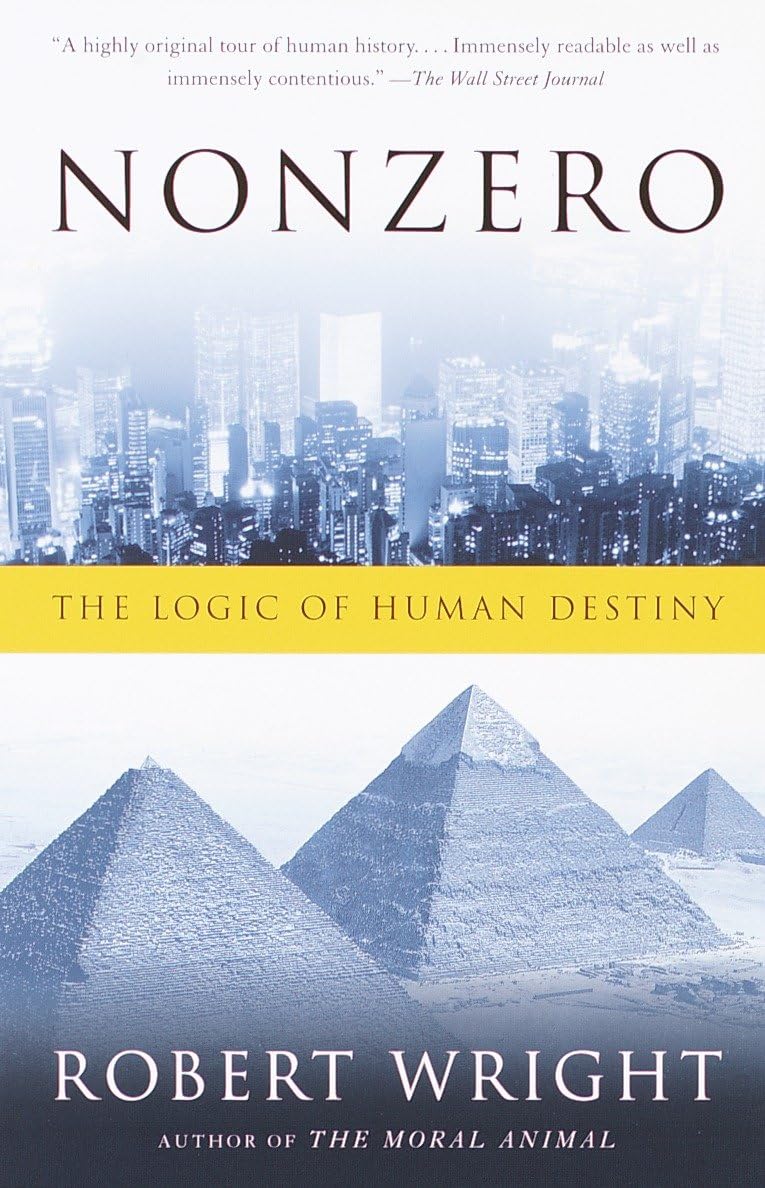
"Nonzero" transmuted me from a cynical fatalist into an unrepentant optimist. The gist is that human culture advances when win/win strategies replace win/lose (zero sum) strategies.
Nonzero: The Logic of Human Destiny by Robert Wright
http://www.amazon.com/Nonzero-The-Logic-Human-Destiny/dp/067...
* Consider the apparent self-assembling of the universe over the last 13.8 billion years.
* Consider the seeming overall long-term trend (certainly not a monotonic one) of "improvement" in life. Adapting Gregg Easterbrook's thought experiment [2]: Would you permanently trade places with a random person who lived 1,000 years ago? How about 10,000 years ago? Would anyone, at any time, do so?
It's a defensible proposition that, as theologian Philip Hefner put it, we are created co-creators [3]. To what end? Who knows. But if past performance is any indication, it'll be pretty neat.
From this perspective, conducting one's life in accordance with (a weak version of) Pascal's Wager [4] seems like a reasonable course of action.
[1] http://www.amazon.com/Nonzero-The-Logic-Human-Destiny/dp/067... (not an affiliate link)
[2] http://www.amazon.com/Beside-Still-Waters-Searching-Meaning/... (ditto)
From the publisher's summary at Amazon: "In Nonzero: The Logic of Human Destiny, Wright asserts that, ever since the primordial ooze, life has followed a basic pattern. Organisms and human societies alike have grown more complex by mastering the challenges of internal cooperation. Wright's narrative ranges from fossilized bacteria to vampire bats, from stone-age villages to the World Trade Organization, uncovering such surprises as the benefits of barbarian hordes and the useful stability of feudalism. Here is history endowed with moral significance–a way of looking at our biological and cultural evolution that suggests, refreshingly, that human morality has improved over time, and that our instinct to discover meaning may itself serve a higher purpose. Insightful, witty, profound, Nonzero offers breathtaking implications for what we believe and how we adapt to technology's ongoing transformation of the world."
Get the best books from Hacker News each week
Join 4,500+ subscribers and get the best books mentioned on Hacker News every Thursday.

Robert Wright's book Nonzero, which advocates for these kinds of reforms, deeply influenced my worldview, way back when.
https://www.amazon.com/Nonzero-Logic-Destiny-Robert-Wright/d...
--
I'm a treehugger. During the 90s, I volunteered at Wetlands Conservation Network (WetNet), a short lived Audubon offshoot trying to save the Pacific salmon.
During my time there, I somehow got the impression that all environmental (ecological) challenges could be fixed with better accounting and fair markets.
More than just addressing externalities.
With our salmon, the (economic) winners were timber companies and developers. Who reaped outsized rewards for developing habitat. (Timber companies were turning second growth forests into urban sprawl thru their subsidiaries.)
Other beneficiaries were power (hydroelectric) and some farmers (irrigation).
The biggest losers were the commercial & tribal fishers, anglers, and the hard to quantify "culture".
But for some reason, beyond my experience and understanding, commonsense structural reforms were completely out of bounds.
For instance, (I'm told) that water rights in the West are "use it or lose it", so potato farmers in Idaho continue to grow an oversupply. Whereas if they somehow rent (or transfer) those water rights in an open marketplace, that water could be put to better uses.
--
Note that I've been out of the treehugger game since 2000, so I don't know what, if any progress, has been made since.
Also, I continue to be surprised that Wright's Nonzero thesis apparently hasn't gotten any traction. Neither with the libertarian Freedom Markets™ cultists. Or the weirdly regressive leftists who reject markets and incentives, and continue to conflate corporatism & cronyism with capitalism.
Oh well.