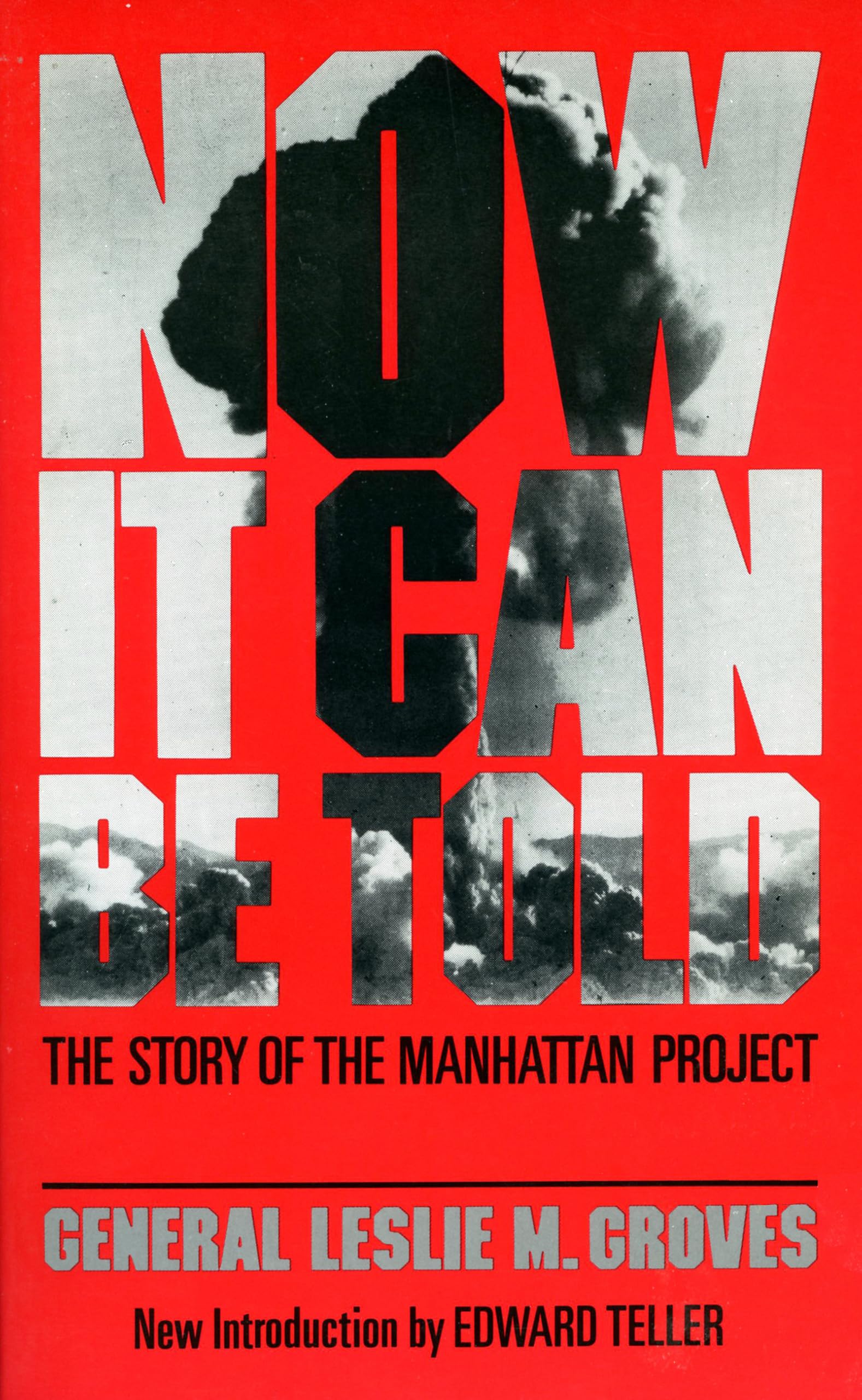
Now It Can Be Told: The Story Of The Manhattan Project
ISBN: 9780306801891
Found in 1 comment on Hacker News
We may earn a commission from purchases made through links on this page.
Not ready yet? Get weekly book picks.
Get the best books from Hacker News each week
Join 4,500+ subscribers and get the best books mentioned on Hacker News every Thursday.

His book, Carrying The Fire, https://www.amazon.com/Carrying-Fire-Astronauts-Michael-Coll... is one of the reasons why I've decided to go into aerospace and take my shot at becoming an astronaut as an adult. He wrote parts of this book in orbit around the moon, and the rest when he came back to Earth. It is hard to describe the degree of tender self awareness that he possessed and the insight with which he wrote.
His book is one of the few books where the forwards are just as important as the book itself. Here's one he recently wrote,
> Could I be one of twelve of eighteen thousand? No way in hell.
It is rare for someone to acknowledge the locus at which the sum of their perspiration and preparation collided with the vagaries of fate. It is rarer still for them to say that had they been born later, or had the circumstances been any different, they might not have been the same. And it is far rarer for someone to talk about the mistakes of youth with this level of humor and care,
> Never mind the excuses, I was a mediocre student, more interested in athletics than academics. I was captain of the wrestling team, but even that was a bit tainted, as I was also a secret smoker. Stupid.
He had, as he admits in the forward, ADHD that went undiagnosed at the time. His teachers thought he was lazy, and he struggled in school. His grades were subpar, and at some point he woke up and he was thirty, writing,
> How had I managed to take so long to get so little done — no advanced degree, a piddling two thousand hours’ flying time, thirty years old, and nothing special in my record to offset these deficiencies?
A lot of books by people who have experienced what it is like to have history's eye upon them don't go into such details. And if they do, they tend to be written by others or they suffer from terminal self-aggrandizement. Collins' account doesn't suffer from this. It feels so raw and real, an inner exploration just as much an outer one.
It's as if we sent on Apollo 11 not just a preternaturally calm man with oodles of the Right Stuff (Neil Armstrong) and a brilliant aerospace engineer (Buzz Aldrin), but also a self-aware artist who recorded some of the most beautiful images of the trip and tried to capture the beauty of what he saw in front of him in verse. A man who can recite passages from Paradise Lost from heart and talks about the importance of bringing art and joy into the sciences. https://twitter.com/AstroMCollins/status/1313882376225734656
NASA chose well.
Here's one final quote from Carrying The Fire,
> Of course, Apollo was the god who carried the fiery sun across the sky in a chariot. But beyond that, how would you carry fire? Carefully, that's how, with lots of planning and at considerable risk. It is a delicate cargo, as valuable as moon rocks, and the carrier must always be on his toes lest it spill.
> I carried the fire for six years, and now I would like to tell you about it, simply and directly as a test pilot must, for the trip deserves the telling.
.
On a related note (apologies for the shameless plug), I'm making my first side project, I want to build a place where I collect books like Carrying The Fire. I want to collect books that answer the question, "if you are an expert in field X, what book do you think someone should read by/about your field?" (at basic, intermediate, and advanced levels)
The idea is to make the kind of resource I wish existed. For example, Carrying The Fire was written in 1974 and is a first hand account of humanity's greatest adventure, and yet few have read it. Why? Simply because most folks never hear of it. You have to be obsessed with space to come across it, and yet reading his account should benefit everyone. It explores how someone with flaws can do something extraordinary, and all the ups and downs in between.
Another example is General Leslie Groves' Now It Can Be Told. https://www.amazon.com/Now-Can-Be-Told-Manhattan/dp/03068018... Groves was the manager behind the Manhattan Project and his book covers how he made The Bomb happen, organisationally. How do you create an organisation that can achieve the impossible? He lays out his lessons in project management, how he selected personnel etc, in digestable chunks. It should be on every founder's desk, and yet it's not, because it's arcane and you only really know about it if you are into military history and this very arcane form of atomic history.
I want to build a resource that helps cross-pollinate across fields. And I'm hoping that some of you would be kind enough to sign up to be our guinea pigs here, http://www.projectkarl.com