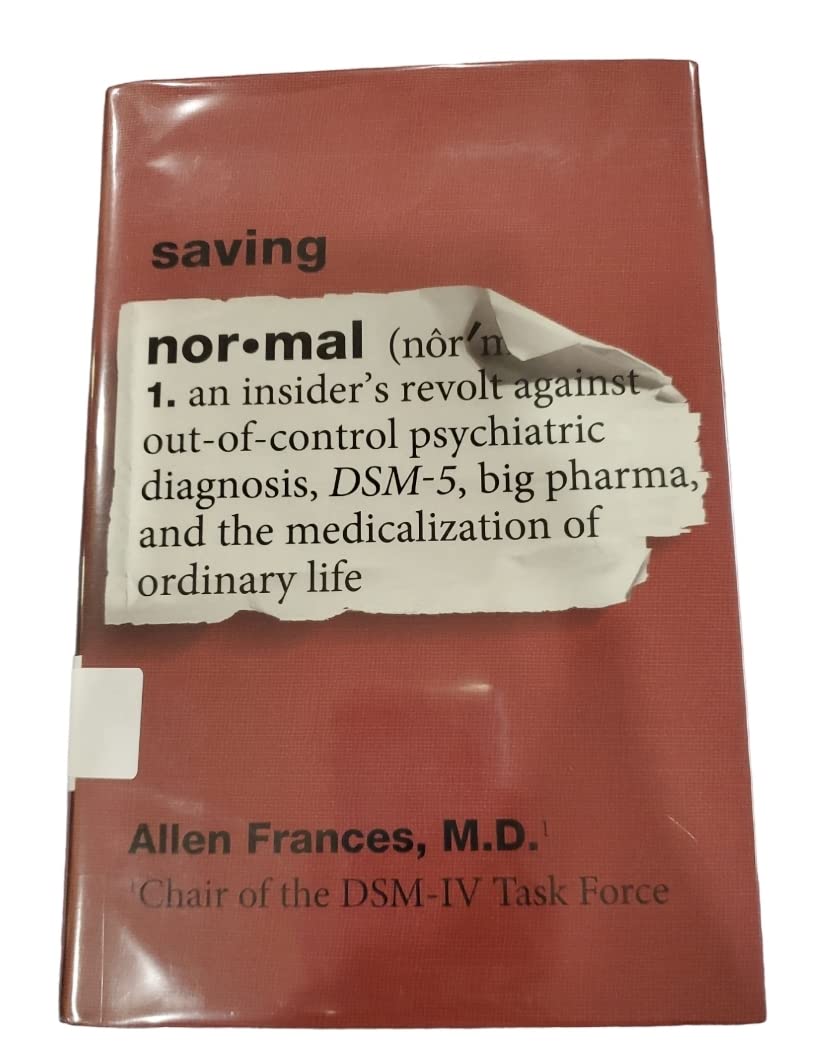
Saving Normal: An Insider's Revolt Against Out-of-Control Psychiatric Diagnosis, DSM-5, Big Pharma, and the Medicalization of Ordinary Life
ISBN: 0062229257
Found in 1 comment on Hacker News
We may earn a commission from purchases made through links on this page.
Not ready yet? Get weekly book picks.
Get the best books from Hacker News each week
Join 4,500+ subscribers and get the best books mentioned on Hacker News every Thursday.

The people you're talking about aren't denying the existence of real disorders, they're denying the existence of phony disorders -- and there are plenty.
Asperger's, popular a few years ago, is now recognized as a myth and has been removed from the DSM. Until the mid-'70s homosexuality was listed among the phony mental illnesses, finally removed after much pressure was put on the practitioners of this pseudoscience.
> The science on this is very strong.
The science of this is practically nonexistent. Are you aware that the director of the NIMH, the highest-ranking psychiatrist in the country, has recently decided to pull the plug on the DSM, describing it as too unscientific to be useful? And that, by pulling the plug on psychiatry's "Bible", he pulled the plug on psychiatry's dubious standing as a science?
> The problems these disorders cause the individual are very real and unmistakeably negative.
No more real than the average placebo response, which as time passes is becoming the default assumption that must be taken into account and that cannot be categorically eliminated until science eventually enters the field.
There is a core of very serious cases, like schizophrenia and some bipolar sufferers, but those are not mental illnesses, they are physical ailments with psychological symptoms. Purely mental illnesses have no scientific explanation, no reliable diagnostic criteria, and no treatments -- which is why the DSM is being abandoned.
> Sometimes conspiracy nuts equate mental disorders with some kind of "dissident" behavior that has to be censors.
You mean, like the editor of DSM-IV, now a critic of the mental health field, who has just written a book arguing that the epidemic of overdiagnosis collides with natural diversity? Like that? Are you aware that nature thrives on a wide spectrum of behaviors, that such a spectrum represents the genesis of all future improvements in the species?
"Saving Normal" (Allen Frances): http://www.amazon.com/Saving-Normal-Out-Control-Medicalizati...
NIMH director Insel: http://www.nimh.nih.gov/about/director/2013/transforming-dia...
Quote: "While DSM has been described as a “Bible” for the field, it is, at best, a dictionary, creating a set of labels and defining each. The strength of each of the editions of DSM has been “reliability” – each edition has ensured that clinicians use the same terms in the same ways. The weakness is its lack of validity."
Couldn't have said it better myself.