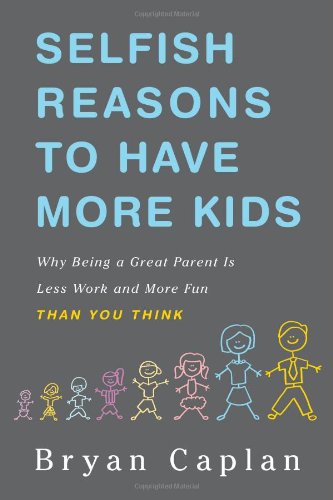
This is the thesis of Bryan Caplan.
He has gathered a lot of evidence (mainly from twin studies) suggesting that the specific details of how you raise your kids don't matter much [1] - your kids will turn out to be the average of their parents + regression to the mean.
I.e., by age 25, the children of Amy Chua and slacker dad will turn out the same, regardless of whether Chua or slacker gets their way.
WSJ article: http://online.wsj.com/article/SB1000142405274870428950457531...
Book: http://www.amazon.com/gp/product/0465028616/ref=as_li_ss_tl?...
[1] Within the bounds of non-abusive middle class first-world parents. As one example, if both parents are religious, the child is likely to be religious. The only factor the parents have significant influence over is Lutheran vs Catholic.
a) innate talent exists and is important
b) practice is also important
are not incompatible.
As for correlation between IQ and various professions, not to mention wages, there is plenty of statistically significant data on this. See for example [1], which shows excellent correlations between AFQT (the US Army's IQ-like test) scores and post-military wage (not to mention many specific objectively graded tasks within the armed forces).
(Note that IQ test-retest scores tend to be highly correlated - it's rare that a child scoring 1 stdev below the mean will later score 1 stdev above the mean.)
In the particular case of math proofs (which I think you're referring to) you have the additional issue that (I think - I'm not a mathematician) proofs often require intuitive leaps...Teaching intuition/pattern-matching is of course really hard.
True. But nevertheless, some students pick it up immediately while others never do. The question arises, why?
Also, as for what is "well accepted", there are lots of things in the field of education that are well accepted but false. For example, people widely believe that test prep significantly improves SAT scores [2]. They also believe school quality (rather than % of Asian students) explains many of the differences in test outcomes between US schools and Asian schools [3]. See also Bryan Caplan's book [4] which shows lots of evidence that most of what is done to children before age 18 has little effect on adult outcomes.
So if you have evidence that public schools and private schools significantly affect outcomes, go ahead and post it. But most of the evidence I've seen suggests school quality is dwarfed by non-school factors. People just ignore the evidence because they don't like the conclusion.
[1] Handbook of the economics of education, by Hanushek and Welch
[2] Studies funded by parties other than Kaplan tend to disagree. http://online.wsj.com/article/SB124278685697537839.html
[3] http://en.wikipedia.org/wiki/Trends_in_International_Mathema...
[4] http://www.amazon.com/Selfish-Reasons-Have-More-Kids/dp/0465...
Get the best books from Hacker News each week
Join 4,500+ subscribers and get the best books mentioned on Hacker News every Thursday.