http://news.ycombinator.com/item?id=3319177
was able to verify what I had read in other official sources on international testing programs, namely that United States students underperform (because their schools underperform) on an ethnicity-matched basis. One detailed report on the issue that I think you will find to be interesting reading is the Education Next report on mathematics learning opportunities for top mathematics students in the United States,
http://educationnext.org/teaching-math-to-the-talented/
which shows that United States students miss opportunities in school to develop their abilities to the fullest. A look at the content of mathematics textbooks in different countries, and specialized studies on differences in teaching practices
http://www.amazon.com/Knowing-Teaching-Elementary-Mathematic...
http://www.amazon.com/Teaching-Gap-Improving-Education-Class...
in different countries have helped me understand the differences I frequently observe between people of the same ethnicity who received their primary and secondary education in different countries.
http://www.amazon.com/Vision-Elementary-Mathematics-W-Sawyer...
http://www.amazon.com/Learning-Gap-Schools-Japanese-Educatio...
http://www.amazon.com/Teaching-Gap-Improving-Education-Class...
http://www.amazon.com/Knowing-Teaching-Elementary-Mathematic...
you could learn something new that could help you better understand the other countries in the world and what the United States might learn from them.
Chapter 1: "International Student Achievement in Mathematics" from the TIMSS 2007 study of mathematics achievement in many different countries includes, in Exhibit 1.1 (pages 34 and 35)
http://pirls.bc.edu/timss2007/PDF/T07_M_IR_Chapter1.pdf
a chart of mathematics achievement levels in various countries. Although the United States is above the international average score among the countries surveyed, as we would expect from the level of economic development in the United States, the United States is well below the top country listed, which is Singapore. An average United States student is at the bottom quartile level for Singapore, or from another point of view, a top quartile student in the United States is only at the level of an average student in Singapore. I have lived for years in one of the other countries that regularly outperforms the United States in those studies, Taiwan, and will also comment on the Taiwan educational experience as a reality check on the comments on Finland in this thread.
I am amazed that persons from Singapore in my generation (born in the late 1950s) grew up in a country that was extremely poor (it's hard to remember that about Singapore, but until the 1970s Singapore was definitely part of the Third World) and were educated in a foreign language (the language of schooling in Singapore has long been English, but the home languages of most Singaporeans are south Chinese languages like my wife's native Hokkien or Austronesian languages like Malay or Indian languages like Tamil) and yet received very thorough instruction in mathematics. Singapore is very diverse linguistically--the MAJORITY of the population in my generation spoke NONE of the four official languages (Mandarin Chinese, Malay, Tamil, or English) in standard form at home, and certainly not the main language of school instruction, English, but Singapore has become part of the "outer circle" of use of English internationally and now maintains a high degree of multilingualism. I hope that all of us here in the United States can do at least that well both in language learning and in mathematics learning in the current generation.
The article "The Singaporean Mathematics Curriculum: Connections to TIMSS"
http://www.merga.net.au/documents/RP182006.pdf
by a Singaporean author explains some of the background to the Singapore math materials and how they approach topics that are foundational for later mathematics study. The key aspect of Singapore's success is a MUCH better curriculum in primary school mathematics than is used in the United States. Homeschoolers in the United States, including quite a few parents of top-scoring students on the American Mathematics Competitions tests, have become aware of the Singapore curriculum materials,
http://www.singaporemath.com/Primary_Mathematics_Stds_Ed_s/1...
and those are generally helpful for American families who are looking for something better than the poorly organized, often mathematically incorrect materials used in United States schools.
Professor Hung-hsi Wu of the University of California--Berkeley has written about what needs to be reformed in United States mathematics education.
http://math.berkeley.edu/~wu/Lisbon2010_4.pdf
http://math.berkeley.edu/~wu/Lisbon2010_2.pdf
http://math.berkeley.edu/~wu/NCTM2010.pdf
http://math.berkeley.edu/~wu/NoticesAMS2011.pdf
http://math.berkeley.edu/~wu/CommonCoreIV.pdf
Other mathematicians who have written interesting articles about mathematics education reform in the United States include Richard Askey,
http://www.aft.org/pdfs/americaneducator/fall1999/amed1.pdf
http://www.math.wisc.edu/~askey/ask-gian.pdf
Roger E. Howe,
http://www.ams.org/notices/199908/rev-howe.pdf
Patricia Kenschaft,
http://www.ams.org/notices/200502/fea-kenschaft.pdf
and
James Milgram.
ftp://math.stanford.edu/pub/papers/milgram/milgram-msri.pdf
ftp://math.stanford.edu/pub/papers/milgram/report-on-cmp.html
All those mathematicians think that the United States could do much better than it does in teaching elementary mathematics in the public school system. I think so too after living in Taiwan twice in my adult life (January 1982 through February 1985, and December 1998 through July 2001). I have seen (and used) the textbooks from Singapore and from Taiwan. They are much more clear in their presentation and much more conceptually accurate than the typical United States textbooks. Moreover, elementary mathematics teachers tend to specialize in teaching mathematics while other elementary teachers teach other subjects, at much younger ages than when United States pupils typically encounter specialist teachers. The United States model of elementary education is to have teachers who are jacks of all trades and masters of none, and who do equally poorly (by reasonable international standards) in teaching reading, mathematics, science, and all other elementary subjects.
The United States could do a lot better and reach the level of Finland by staffing reforms
http://edpro.stanford.edu/hanushek/admin/pages/files/uploads...
and by using best practices
http://www.amazon.com/Teaching-Gap-Improving-Education-Class...
in provision of elementary education.
http://www.paulgraham.com/hs.html
This essay was the second essay (after "Why Nerds Are Unpopular) that made me aware of pg's interest in education policy.
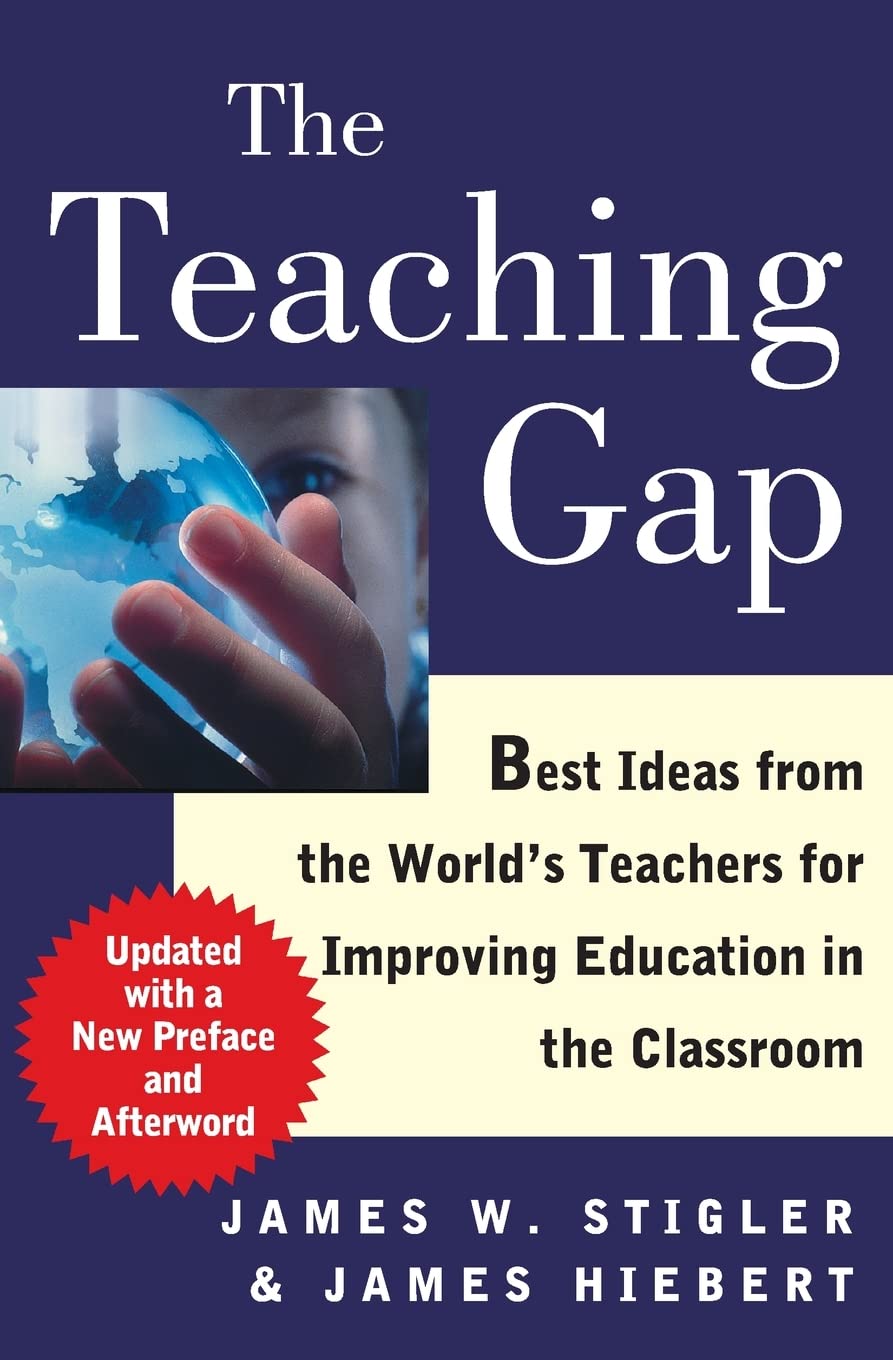
See also the book The Teaching Gap: Best Ideas from the World's Teachers for Improving Education in the Classroom for ways that school could be done better.
http://www.amazon.com/Teaching-Gap-Improving-Education-Class...
Where my wife grew up, it took one teacher to teach 60 pupils. A class size of 50 was an exceptionally small class size. Several of the countries that best the United States in academic achievement
http://timss.bc.edu/PDF/t03_download/T03_M_Chap1.pdf
have much higher class sizes per teacher than the United States has. It is definitely possible to improve teacher productivity over the low level maintained in the United States. There are whole books on the subject.
http://www.amazon.com/Learning-Gap-Schools-Japanese-Educatio...
http://www.amazon.com/Smart-Schools-David-Perkins/dp/0028740...
http://www.amazon.com/Teaching-Gap-Improving-Education-Class...
http://www.amazon.com/Knowing-Teaching-Elementary-Mathematic...
That's a mistake of the system in the United States. In many other countries, teachers specialize by subject in the elementary grades, the better to teach their subject effectively. See Knowing and Teaching Elementary Mathematics: Teachers' Understanding of Fundamental Mathematics in China and the United States
http://www.amazon.com/Knowing-Teaching-Elementary-Mathematic...
for a detailed discussion of elementary math teaching, or The Teaching Gap: Best Ideas from the World's Teachers for Improving Education in the Classroom
http://www.amazon.com/Teaching-Gap-Improving-Education-Class...
for a broader perspective on other ways to organize schools.
Get the best books from Hacker News each week
Join 4,500+ subscribers and get the best books mentioned on Hacker News every Thursday.

http://norvig.com/experiment-design.html
(By the way, the scatter of data points around the regression line in their plot suggests that the model is subject to large degrees of error in prediction.) It would take an experimental design (randomly assigning one group of teachers in the same country to receive pay raises while another group does not, with before-and-after comparisons of pupil performance) to show that paying teachers more results in higher pupil performance.
http://escholarship.org/uc/item/6hb3k0nz
There have been hundreds of studies of educational interventions over the years,
http://www.amazon.com/Visible-Learning-Synthesis-Meta-Analys...
and many thoughtful international comparisons of teaching practice,
http://www.amazon.com/Teaching-Gap-Improving-Education-Class...
http://www.amazon.com/Knowing-Teaching-Elementary-Mathematic...
http://www.amazon.com/Making-Learning-Whole-Principles-Trans...
but none of those conclude that simply raising teacher pay, without changing teaching practices and perhaps also the composition of the teaching workforce, will have much to do with raising pupil performance in any place. Raising teacher pay systematically has been tried in the United States (notably in the state of Connecticut) and has not been shown to markedly raise pupil performance.
An economist who closely studies education policy has suggested that pay and other incentives be used to encourage the least effective teachers to seek other occupations while rewarding the most effective teachers with increased compensation and more professional support.
http://edpro.stanford.edu/hanushek/admin/pages/files/uploads...
Such a policy, he estimates (showing his work in his article) would raise United States educational achievement to the level of the highest-performing countries. This is something worth verifying by experiment, although that will be politically difficult in any state of the United States
http://www.cato.org/pubs/journal/cj30n1/cj30n1-8.pdf
and perhaps in Britain as well.
http://www.economist.com/node/17849199
P.S. I'm curious about why the United States underperforms so much compared to salaries paid to teachers in the chart shown in the submitted blog post.