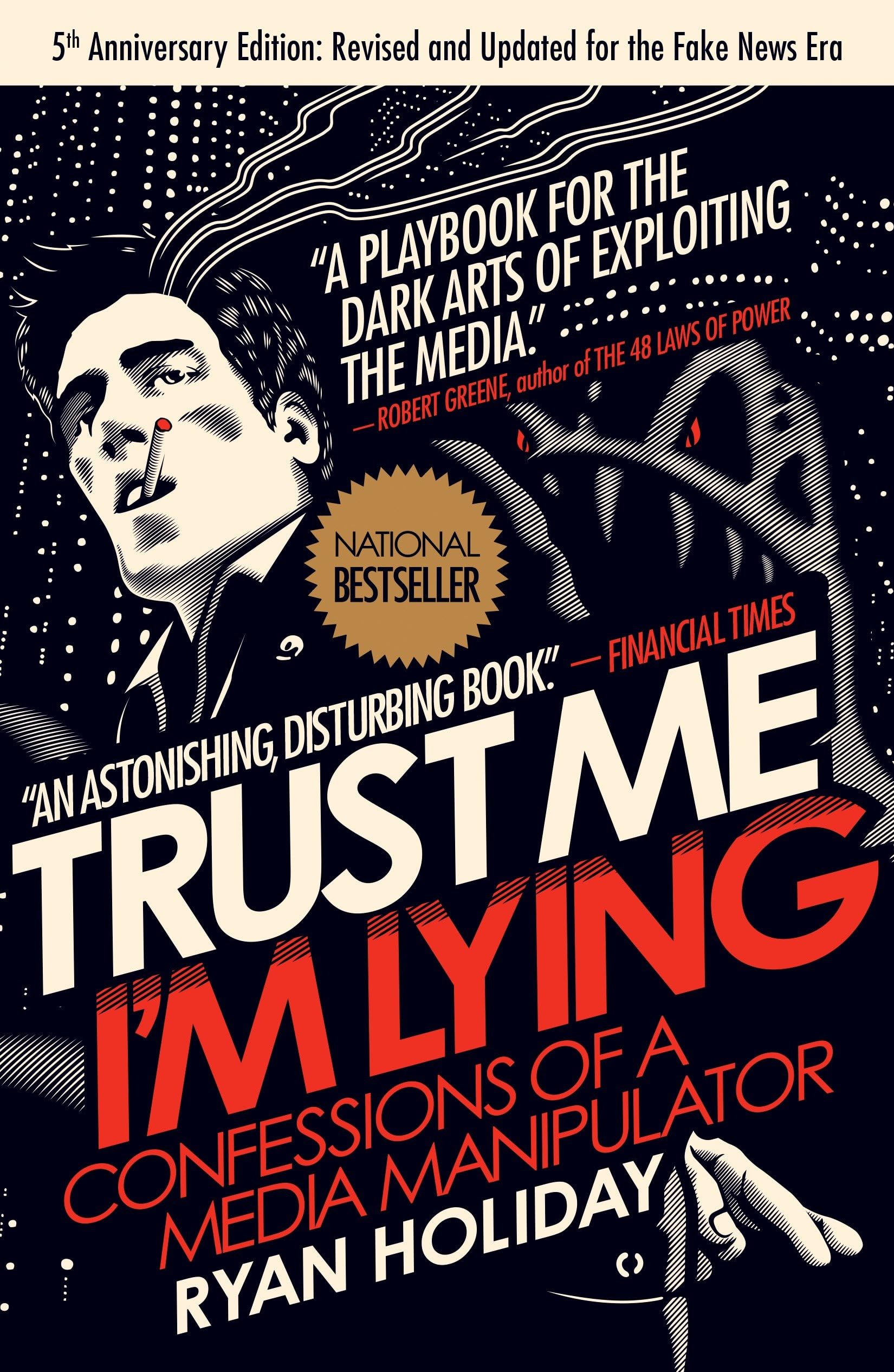
But it is interesting to note that he seems to have gotten into Stoic philosophy to make up for the sins that he committed as a digital marketer. Of his books, his expose on social media and digital marketing, https://www.amazon.com/Trust-Me-Lying-Confessions-Manipulato..., is my favorite.
If you are not familiar but interested in learning more. This book is a good primer: https://www.amazon.com/dp/B0074VTHH0/ref=dp-kindle-redirect?...
I also really recommend this book https://www.amazon.com/Trust-Me-Lying-Confessions-Manipulato...
The type of attack is a lot more oldschool but nonetheless, pretty effective.
Maybe none. But one way the times could re establish credibility with me is to be transparent about how much the writer engaged with pr reps or communications teams in each story. It doesn't have to be exhaustive.
By the way- Part of my journey to this level of skepticism was "Trust me, I'm Lying" by Ryan Holiday https://www.amazon.com/Trust-Me-Lying-Confessions-Manipulato...
I disagree that we're clearly worse off. For a good explanation on why, this is a pretty good read:
https://www.amazon.com/Trust-Me-Lying-Confessions-Manipulato...
The thesis, for those less interested in buying the book, is that when we embraced blogs like Gawker and Buzzfeed as a source of news content, the quality of our news decreased drastically.
You went from sort of the New York Times subscription-based model, where people are subscribed already and your journalists can focus on the quality of your content, back to the days of "EXTRA! Read all about it," where everyone is just trying to be heard over the thousands of other available blogs.
So our headlines became clickbait, content became lies, and because it's so pervasive, there is little to no accountability.
The hogan case is important because it adds accountability.
I wouldn't be surprised if they announce the price before that timer goes away, just to get another round of press.
[0] Stuff like this is outlined in "Trust Me, I'm Lying" - http://www.amazon.com/Trust-Me-Lying-Confessions-Manipulator...
For anyone that's equally confused, I highly recommend reading the book "Trust Me, I'm Lying": http://www.amazon.com/Trust-Me-Lying-Confessions-Manipulator...
What's happening right now isn't entirely intuitive, so it's understandable to be a bit lost, but what the parent is talking about is a serious, legitimate issue.
Admittedly, I don't have evidence to suggest this, but I wouldn't be surprised if this was just a publicity stunt.
Edit: I'm not claiming the hack was a publicity stunt, I'm claiming that I wouldn't be surprised if the cancelation of the movie was a publicity stunt.
http://www.amazon.com/Trust-Me-Lying-Confessions-Manipulator...
Ever read this?
Get the best books from Hacker News each week
Join 4,500+ subscribers and get the best books mentioned on Hacker News every Thursday.

Many people have talked about and analyzed this. But the analysis that I find most insightful is also the first one that I read. https://www.amazon.com/Trust-Me-Lying-Confessions-Manipulato.... It not only discusses how the dynamics of what goes viral leads to polarization, it also explains how the economics of how news is delivered today mirror those that created the yellow press over a century ago. And why both wind up delivering polarizing conspiracy theories with limited factual accuracy.
I have no idea what to do about the problem. But at least I feel that I can understand it.