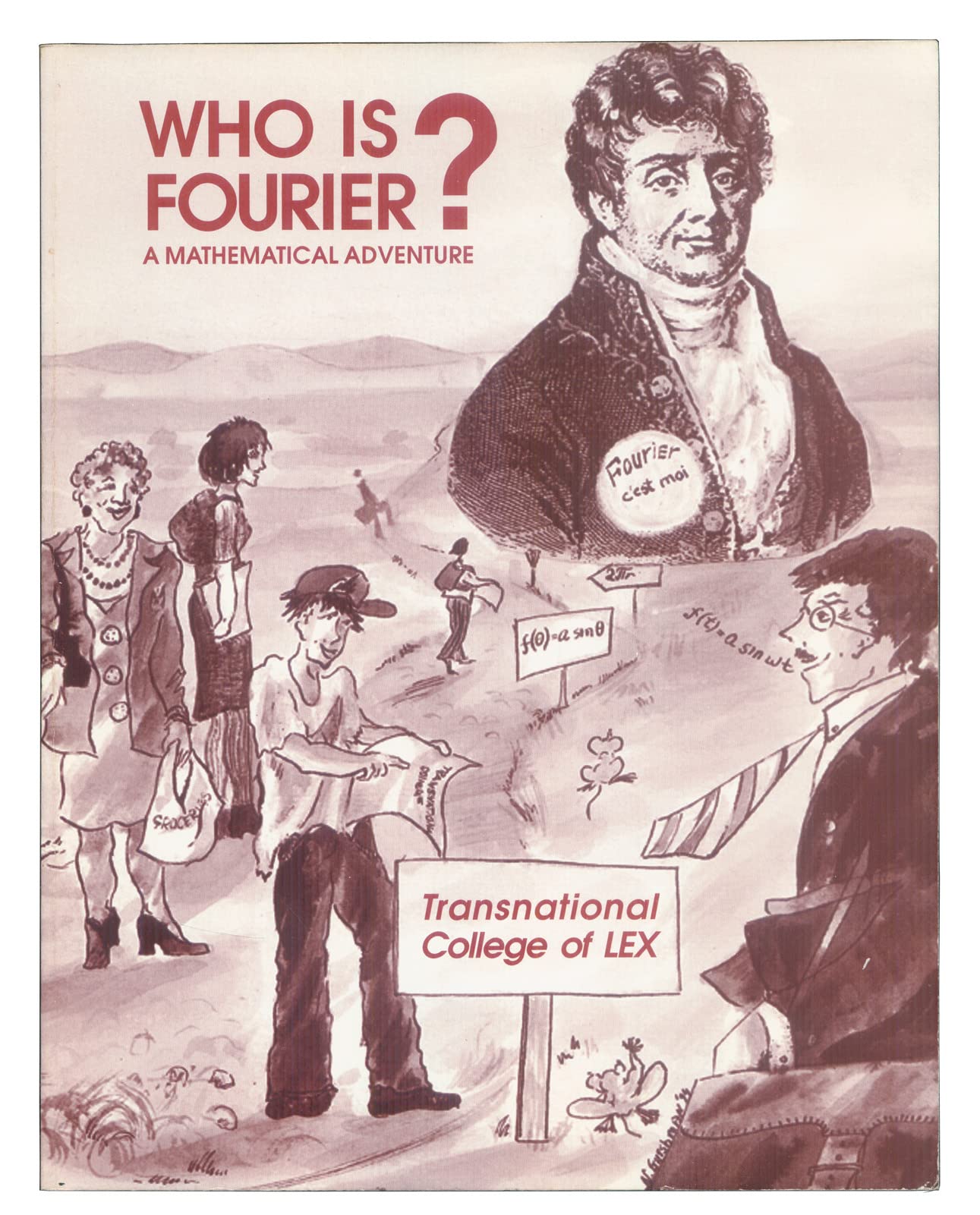
Who Is Fourier?: A Mathematical Adventure
https://www.amazon.com/Who-Fourier-Mathematical-Transnationa...
It started off as a bunch of non-math literate folks teaching themselves math from scratch, including trigonometry, calculus etc, and ending in Fourier series. It is a very approachable and fun book.
It is called "Who is Fourier: A Mathematical Adventure".
I was tremendously surprised by this unusual gem of a book. It covers the range from basic arithmetic to logarithms, trigonometry, calculus to fourier series.
https://www.amazon.com/Who-Fourier-Mathematical-Adventure-2n...
Start with some school textbooks for grades 8-12 i.e. Secondary Education. This is more for a refresher course in the absolute basics.
The above can be supplemented with the following books to develop intuition;
1) Who is Fourier - https://www.amazon.com/Who-Fourier-Mathematical-Adventure-2n...
2) Functions and Graphs - https://www.amazon.com/Functions-Graphs-Dover-Books-Mathemat...
After this is when you enter undergraduate studies and you have to fight the dragon of "Modern Maths" which is more abstract and conceptual. In addition to standard textbooks; i suggest the following;
1) Concepts of Modern Mathematics - https://www.amazon.com/Concepts-Modern-Mathematics-Dover-Boo...
2) Mathematics: Its Content, Methods and Meaning - https://www.amazon.com/Concepts-Modern-Mathematics-Dover-Boo...
3) Mathematical Techniques (i am linking this so you can see the reviews but get the latest edition) - https://www.amazon.com/Mathematical-Techniques-Dominic-Jorda...
Finally, if you would like to learn about all the new-fangled mathematics your best bets are;
a) The Princeton Companion to Mathematics - https://www.amazon.com/Princeton-Companion-Mathematics-Timot...
b) The Princeton Companion to Applied Mathematics - https://www.amazon.com/Princeton-Companion-Applied-Mathemati...
One important piece of advice that i have is to become comfortable with the Symbols, Notation and Formalism used in Mathematics. Most students are intimidated by the Formalism (which is nothing more than a precise form of shorthand to express abstract concepts) and give up on studying Mathematics altogether. This is a shame since it is merely the Form and not the Function of Mathematics.
So, the feer of a math intensive grad program (and admission had me worried). My CS program offered some math refresher, but I ended up just jumpting in without it. If the program is decent, you will be guided along at a digestable pace. As a responsible adult with a hunger to learn, and you will enjoy and digest more. In a curriculum, you'll also have peers/teachers to help you when absolutely stumped - which will happen.
For books - I just have one that I saw referenced here on HN, which is a little odd, but highly recommend for understanding Fourier transforms [1].
1. Who Is Fourier? A Mathematical Adventure 2nd Edition... Amazon link: https://www.amazon.com/dp/0964350432/ref=cm_sw_r_other_apa_i...
The only math assumed going in is basic high school algebra.
They also have a book on quantum mechanics ("What is Quantum Mechanics? A Physics Adventure" [3]) and biology ("What is DNA? A Biology Adventure"[4]).
[1] https://www.amazon.com/Who-Fourier-Mathematical-Adventure-2n...
[2] https://en.wikipedia.org/wiki/Hippo_Family_Club#Transnationa...
[3] https://www.amazon.com/What-Quantum-Mechanics-Physics-Advent...
[4] https://www.amazon.com/What-Biology-Adventure-Transnational-...
Get the best books from Hacker News each week
Join 4,500+ subscribers and get the best books mentioned on Hacker News every Thursday.

https://www.amazon.com/Who-Fourier-Mathematical-Transnationa...